


Why Kim Jong-un Spent Two Consecutive Birthdays
Visiting Civilian Economic Facilities

Lee Seung-hyun
Research Fellow at SAND Institute
Ph.D. in Public Administration
drharacearthur@gmail.com
North Korean leader Kim Jong-un attended the completion ceremony of a local industrial factory in Chaeryong County, South Hwanghae Province, on January 8, his 41st birthday. While not officially recognized externally, the day is celebrated domestically. Last year, state media featured his visit to a chicken factory with his daughter, Kim Ju-ae, on his 40th birthday.
Since 2023, North Korea has organized events to commemorate Kim Jong-un's birthday, elevating it to a national holiday. On January 8, 2024, institutions nationwide held "Loyalty Pledge Meetings" in his honor. Stepping out of his predecessors' shadow, Kim has sought to present himself as a "leader for the people" by visiting civilian sites on his birthday for two consecutive years.
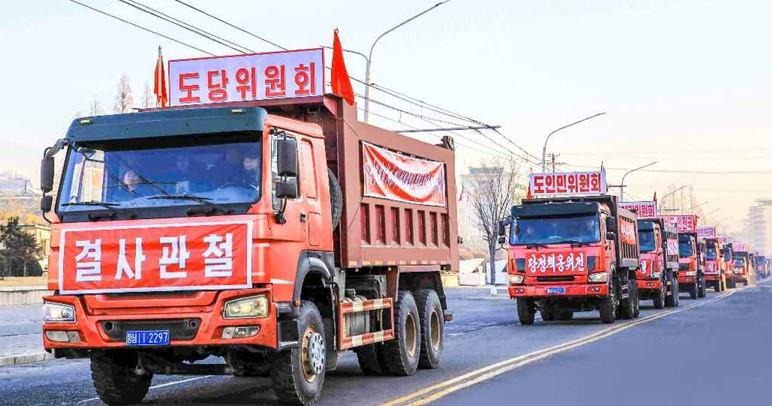
North Korea's trucks/Chosun Central Television carrying compost to rural areas
The recently completed Chaeryong County Local Industrial Factory is part of Kim’s "20x10 Regional Development Policy," a major initiative launched last year. Footage released by North Korean media showed Kim attending the outdoor ceremony in freezing weather, hands tucked into his coat pockets, with a stiff expression, seemingly due to the cold.
The media's coverage of his birthday visit appears intended to stabilize public sentiment amid prolonged economic challenges and present the new factory as a beacon of hope for economic revitalization.
At the event, Kim Jong-un declared, "The consecutive completion ceremonies for local industrial factories in 20 cities and counties bring immense joy to the people as we embark on a fruitful new year." However, the footage revealed modest production facilities, exposing the harsh economic realities where even small food factories are framed as major achievements.
In December 2024, at the 11th Plenary Meeting of the Workers' Party's 8th Central Committee, Kim praised the nation's economic achievements, using the session as a de facto New Year’s address. However, closer scrutiny reveals inconsistencies.
At the plenary meeting, North Korea touted 2024 accomplishments, including 127% in rolled steel, 106% in nonferrous metals, 103% in nitrogen fertilizer, 101% in electricity, 110% in coal, 101% in cement, 104% in timber, 101% in seafood, 108% in railway freight, 101% in textiles, and 107% in grain. However, it did not provide specific production figures.
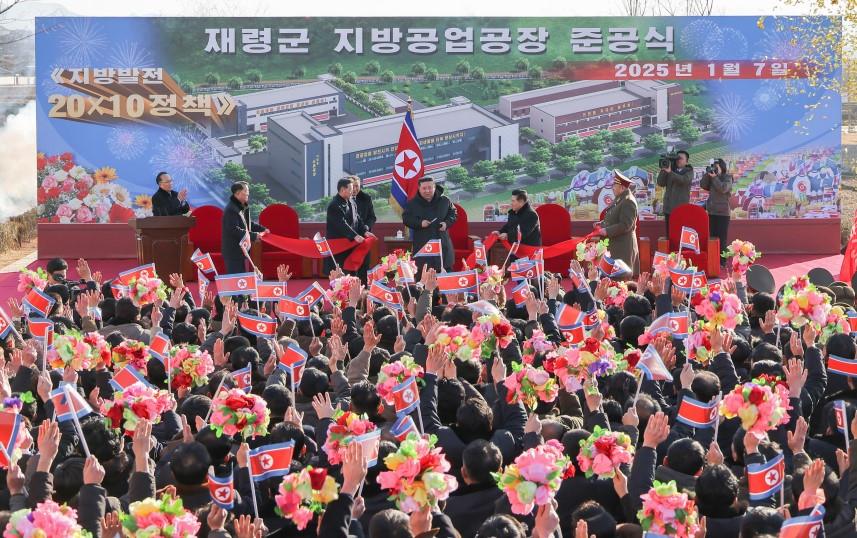
North Korean leader Kim Jong-un attended the completion ceremony of a local industrial plant in Jaeryeong-gun,
South Hwanghae Province, state media reported on the 8th./Chosun Central Television
North Korea has focused heavily on construction projects, which yield visible results and allow for optimistic economic reports. The government has touted achievements such as building 50,000 homes in Pyongyang, rural cultural housing, and local factories—all accomplished through mobilizing military and civilian labor.
Despite these efforts, North Korea’s trade remains at 80% of its 2019 levels, and import volumes declined further in the latter half of 2023.
South Korea's Rural Development Administration reported a 4.78 million-ton drop in North Korea’s food production last year. The "20x10 Regional Development Policy," aiming to build modern factories in 20 counties annually for a decade, faces major challenges. While construction relies on mobilized labor, their operation seems unrealistic.
Under international sanctions, North Korea struggles to secure the materials and equipment required for large-scale projects. With limited state resources, the responsibility for building and running these factories has been shifted to local regions, effectively telling them to "fend for yourselves.“
Kim Jong-un's insistence that local governments prioritize the smooth operation of these factories reflects this trend. However, without essential infrastructure like power and materials, these factories risk becoming empty symbols. Building structures without ensuring functionality is unlikely to yield meaningful results over the next decade.
North Korea's reliance on Russia, weakened by its war with Ukraine, remains a fragile lifeline. Relations with China, a traditional ally, also remained strained last year, despite the 75th anniversary of their ties. Cautious of North Korea-Russia ties and Western reactions, China has kept its distance. Kim Jong-un may seek sanctions relief through arms reduction talks, especially with Donald Trump's return, but the global political landscape is unlikely to align with his goals.