


Kim Myongsung’s Inside North Korea
· Kim Jong-un, Backed by Vladimir Putin, Challenges Donald Trump: "Strengthening Nuclear Power is Irreversible"
· Kim Jong-un Oversees Tests of "Suicide Drones," Orders Mass Production
· 10,000 North Korean Troops Deployed to Russia: Annual Earnings Could Reach $1.3 Billion

Kim Myong-sung
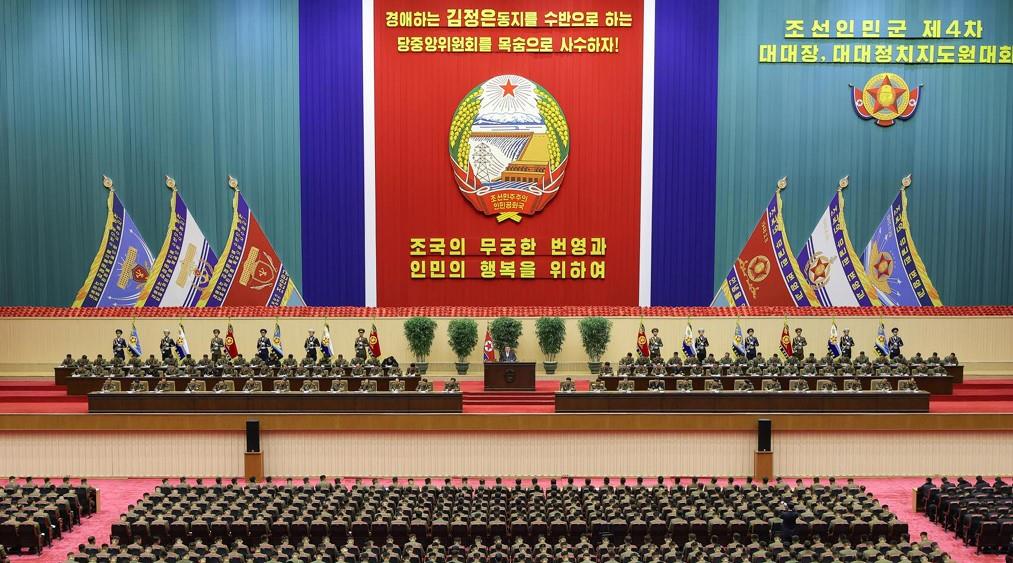
Kim Jong-un delivering a speech at the North Korean Army Battalion Commanders and Political Instructors Conference on the 15th.
/ Korean Central News Agency
Just ten days after Donald Trump’s election victory, North Korean leader Kim Jong-un declared that “the policy of strengthening nuclear power has long become an irreversible course for us.” The statement underscored North Korea’s unwavering commitment to its nuclear arsenal and signaled that any future negotiations with the United States would likely focus on arms reduction rather than denuclearization.
According to KCNA, Kim Jong-un stated in a November 15 speech at the Battalion Commanders and Political Instructors Conference that “the remaining task is to ensure our nuclear power is fully operational at any moment, fulfilling its role as a war deterrent and second mission.” He emphasized ongoing efforts to strengthen national defense, with "war deterrence and secondary mission" since 2022 referring to the practical use of nuclear weapons, including preemptive strikes.
Kim Jong-un criticized the United States following the presidential election, claiming that trilateral military cooperation with South Korea and Japan destabilizes regional peace. He warned that the U.S.-led alliance is expanding into Europe and the Asia-Pacific, posing an increasing threat.
Kim's speech was heavily focused on war preparations, with the word "war" mentioned 37 times and "war preparations" 7 times. He stated, "All levels of our military must fully dedicate their activities to war preparations and strive for their swift completion. Given the current circumstances, completing war readiness is an urgent task that cannot be delayed even for a single day.“
While Kim Jong-un refrained from commenting on North Korea’s involvement in Russia’s military operations, he accused the U.S. and the West of using the Ukraine conflict to expand global military intervention. He described the situation as a deliberate effort to enhance real combat experience and warned of escalating risks that could lead to a third world war. Kim placed the responsibility for this growing tension squarely on the U.S. and its allies.
North Korea's focus on strengthening its nuclear capabilities and prioritizing war readiness after the U.S. election is believed to be heavily supported by Russia.
On November 11, Kim Jong-un ratified the "Treaty on Comprehensive Strategic Partnership," a pact considered a de facto military alliance with Russia. The treaty, swiftly approved two days after Vladimir Putin’s ratification, is expected to formalize deeper military collaboration, including North Korean troop participation in combat and cooperation on nuclear and missile technology.
North Korea’s provocations are also viewed as a calculated move to "raise its stakes" before Donald Trump’s North Korea policy is fully formed. With support from Russia, the regime aims to secure a prominent position in Trump’s foreign policy agenda.
Kim Jong-un oversaw performance tests of North Korea’s self-produced suicide drones and ordered their mass production. Footage of drones striking targets suggests the program has moved from research to production.
State media KCNA reported on November 15 that Kim Jong-un supervised tests of suicide drones developed by research institutions and companies affiliated with the Unmanned Aerial Vehicle Technology Consortium.
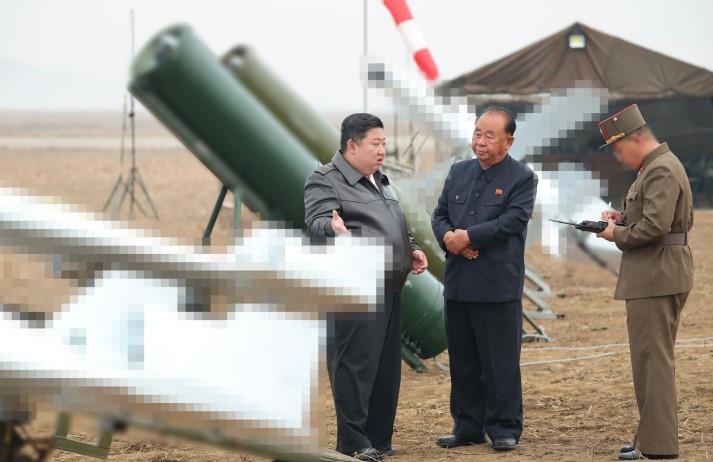
On November 15, North Korean state media reported that Kim Jong-un inspected various domestically produced drones.
/ Korean Central News Agency
KCNA detailed that during the tests, the drones followed tactically predetermined flight paths over varying distances to strike their targets with precision.
Kim emphasized the global race to incorporate drones as key military tools, noting, "The competition to utilize drones as a primary military resource is accelerating worldwide. Their low production costs and simplified manufacturing processes make them an increasingly feasible option for enhancing strike power in new domains." He added that drones had proven their effectiveness in conflicts of all sizes and described their use as an essential emerging demand in modern warfare.
Kim also remarked, "We have the capacity and potential to produce and deploy various types of drones. Moving forward, we will explore the integration of innovative and promising tactical methodologies that align with the demands of modern warfare.“
In a display of their capabilities, North Korea released footage of a drone striking and exploding on a target resembling a BMW sedan, suggesting its potential use for high-profile assassinations in South Korea.
Additional images showed white-painted drones launching or striking targets, as well as Kim issuing directives while standing beside drones arranged on the ground. Filtered images revealed various drone designs, including manta ray-shaped wings, cross-shaped wings, and shorter cylindrical models.
The Unmanned Aerial Vehicle Technology Consortium, which Kim visited, is a relatively unknown entity in North Korean media. The Rodong Sinmun praised the organization for achieving "remarkable progress in implementing directives issued by the Central Committee of the Workers' Party of Korea.“
In August, Kim visited the State Academy of Defense Sciences' drone research institute to observe tests of "various drones." It is believed that North Korea’s establishment of specialized drone research institutes and enterprises signifies a transition from development to mass production, showcasing its advancing unmanned aerial technology.
10,000 North Korean Troops Deployed to Russia: Annual Earnings Could Reach $1.3 Billion
With 10,000 North Korean troops now sent to Russia to participate in the war in Ukraine, experts estimate that Pyongyang’s annual earnings from this deployment could range from $320 million to $1.34 billion (445.1 billion to 1.86 trillion KRW), depending on how the troops are utilized.
In the report “Mercenaries or Allied Forces: Gains and Losses of North Korean Troop Deployment to Russia,” Lim Soo-ho, a senior research fellow at the Institute for National Security Strategy (INSS), examined the economic, strategic, and political implications of deploying 10,000 North Korean soldiers.
The report categorizes the nature of North Korea’s involvement into two types: operating as mercenaries under Russian command or serving as formal allied forces. The pay structure differs significantly based on the chosen arrangement.
Foreign mercenaries in the Russian military earn $2,000–$3,000 per month, plus a $2,000 enlistment bonus. If North Korean troops follow this model, annual earnings could total $320 million, excluding indirect costs like troop management or domestic military compensation, which Russia is unlikely to fund.
If North Korean soldiers serve as allied forces, their earnings could mirror South Korea’s model during the Vietnam War, where troops earned $6,384 annually in today’s terms. In contrast, North Korean mercenaries’ estimated annual income of $32,000 is five times higher. Allied participation could also include additional indirect compensation, as in the Vietnam War, where it was 3.2 times the direct pay. Under this framework, North Korean troops could earn $134,000 each annually, totaling $1.34 billion for the regime.
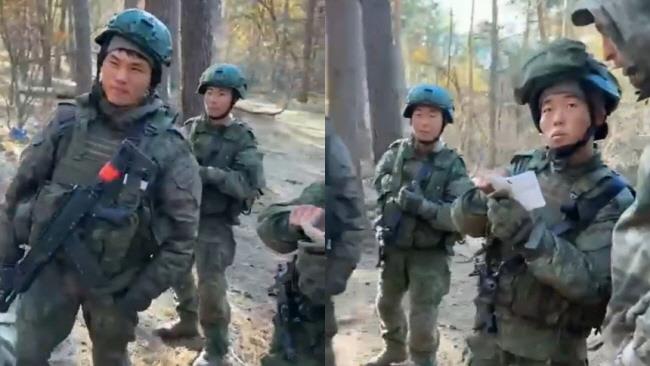
A video shared on Telegram by Ukrainian journalist Andriy Tsaplienko on November 5 shows alleged
North Korean soldiers, captioned, "First video of North Korean troops in the Kursk region." / Telegram
Lim explained, “North Korea’s decision on how to participate is likely to be driven more by strategic considerations than financial ones. They may lean toward acting as formal allies, whereas Russia would likely prefer the mercenary arrangement to avoid extra financial and logistical burdens.”
The report suggests North Korea's main goal is securing military and technological aid from Russia, not just foreign currency. Projected income aligns with current revenues, such as $320 million from cryptocurrency theft, $270 million from overseas workers, and $550 million from illegal coal exports. However, Russian military aid may hold greater long-term value.
-
PREV [NK Focus]
-
NEXT [Analysis of issues]