

North Korean Activities in September and October
Kim Jong-un Intensifies Focus in September and October: 14 of 21 Public Appearances Centered on Military Affairs
- Is Kim Testing His “Three-Day War Plan” Against South Korea by Sending Special Forces to Russia?

Lee Seung-hyun
Research Fellow at SAND Institute
North Korean leader Kim Jong-un focused on military affairs in September and October. North Korean media reported 21 public activities during these months (10 in September, 11 in October), with military engagements comprising 14 of them (7 in each month).
In September, Kim Jong-un conducted 10 public activities, categorized as 2 in politics, 7 in military, and 1 in social/economic affairs, heavily skewed toward military engagements. His military inspections primarily focused on strategic assets such as nuclear and missile capabilities.
In August, Kim prioritized domestic issues and flood recovery, but by September, his focus had shifted almost entirely to military affairs.
* September: 10 activities — 2 in politics, 7 in military, 1 in social/economic
* August: 11 activities — 2 in politics, 3 in military, 6 in social/economic
On September 13, North Korean media reported Kim’s visit to the Nuclear Weapons Institute and a weapons-grade nuclear material facility, where he called for “strengthening the production base” and emphasized expanding centrifuge capacity to build the nation’s nuclear arsenal.

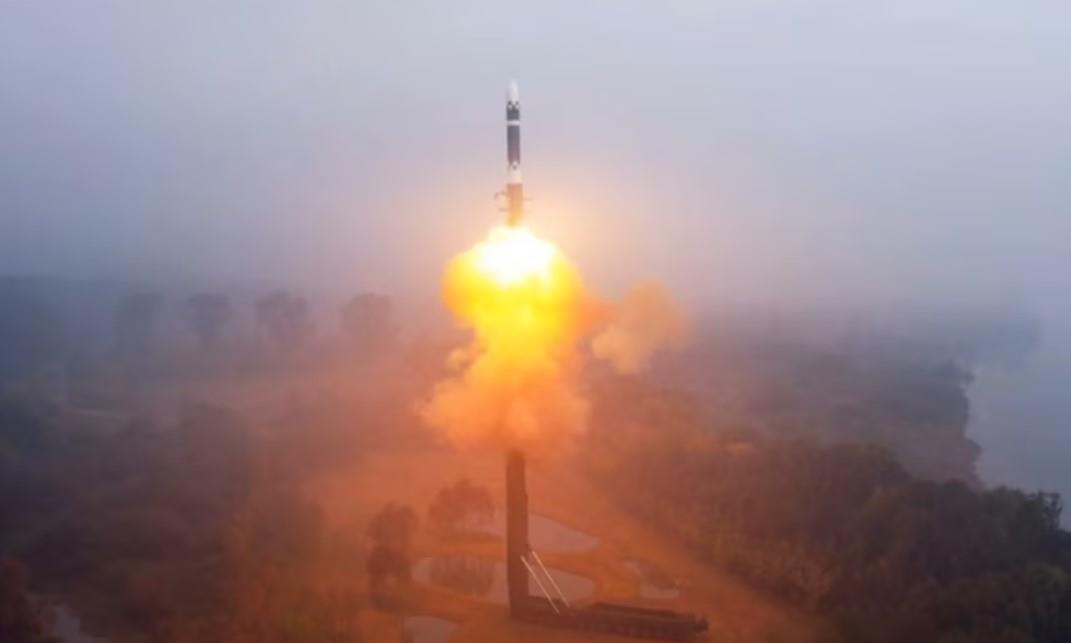
The Hwasong-19, a new intercontinental ballistic missile (ICBM) test-launched by North Korea at an undisclosed
location on the 1st./Korean Central News Agency
Kim also visited the General Missile Bureau and the State Academy of Defense Sciences, announcing a successful September 18 test launch of a new tactical ballistic missile, the “Hwasong-11Da-4.5,” along with an enhanced strategic cruise missile. North Korea revealed that the new missile is capable of carrying a 4.5-ton warhead with an accuracy range of 320 km, highlighting its effectiveness for medium-range targeting. The cruise missile has also been upgraded for combat applications.
Ongoing provocations included deploying trash balloons over South Korea, testing 600mm rocket launchers, and announcing advancements in tactical ballistic and cruise missiles, all of which escalate regional tensions. North Korea's recent disclosure of highly enriched uranium (HEU) production facilities, coinciding with the U.S. election, seems intended to solidify its nuclear status and enhance its negotiating leverage.
In conclusion, North Korea’s focus in September was outward, emphasizing military posturing and signaling to the U.S. Linked to the U.S. election, these provocations are expected to continue but remain restrained. Rather than a seventh nuclear test, North Korea may choose lower-level displays of its nuclear capabilities, such as showcasing delivery systems or conducting drills that don’t directly threaten U.S. security. The September facility disclosures align with this approach.
The continued use of trash balloons targeting South Korea has reportedly been adopted as a new North Korean tactic, likely to persist in the future. This tactic aims to wear down South Korean defenses, drain resources, and inflict economic losses. North Korea may use these provocations to assess South Korea's responses and explore additional tactics for rear-area infiltration.
In October, Kim Jong-un conducted 11 public activities, comparable to the 10 in September, again focusing primarily on military matters.
* September: 10 activities — 2 in politics, 7 in military, 1 in social/economic
* October: 11 activities — 2 in politics, 7 in military, 2 in social/economic
In October, North Korea’s Supreme People’s Assembly cemented a more hostile stance toward South Korea under the “Two Hostile States” doctrine. Kim Jong-un heightened this hostility, stressing ideological unity within the Korean People's Army to bolster internal solidarity and vigilance against external threats.
With Kim Jong-un designating South Korea as a hostile state in October, the North Korean leadership has moved to formalize this stance in its constitution, excluding reunification prospects and extending its threat-focused policy. Kim Yo-jong also issued a critical statement as part of this new approach.
In summary, like in September, Kim Jong-un's focus in October remained on foreign affairs, particularly in the military sector. This included strengthening military cooperation with Russia by signing a "Comprehensive Strategic Partnership Agreement" and deploying special forces—part of the "Three-Day War Plan" announced in 2013—to the Ukraine conflict for combat experience that enhances the feasibility of this plan against South Korea. North Korea is expected to continue sending troops to support Russian forces, supplying weapons, and escalating threats against South Korea, especially with the U.S. presidential election approaching.