

Kim Myongsung’s Inside North Korea
· Kim Jong-un’s Anti-Reunification Act: Destruction of About $133 Million in Assets — August 15th Doctrine Challenges His Two-State Policy
· Kim Yo-jong Involves U.S. about South Korean sending Drones to North: "We Know It’s South" ... "The U.S. Must Take Responsibility"
· Kim Jong-un Gathers Top Military Officials to Discuss Response to Pyongyang Drone Incident

Kim Myong-sung
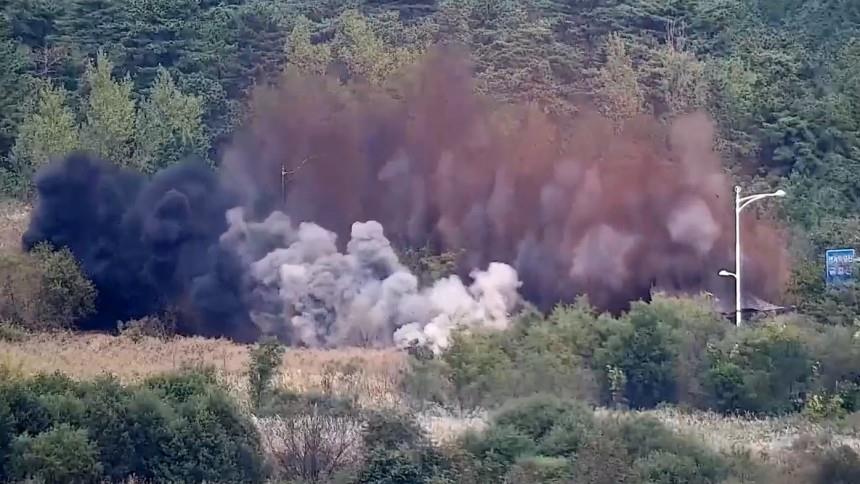
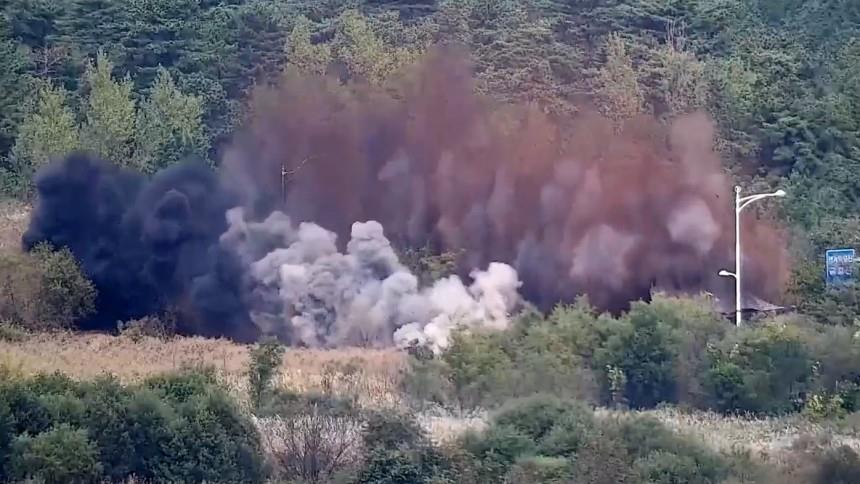
The scene of North Korea destroying the road on the northern side of the Gyeongui Line around noon on the 15th
/ Joint Chiefs of Staff
The destroyed Gyeongui and Donghae roads originated from the 1992 Inter-Korean Basic Agreement under Kim Il-sung, aimed at reconnecting severed infrastructure. The initiative gained momentum after the 2000 inter-Korean summit during Kim Jong-il's rule, with both Koreas holding simultaneous groundbreaking ceremonies in September 2002. At the time, North Korean media expressed optimism, advocating for swift reconnection to achieve national prosperity and unity.
At the end of last year, Kim Jong-un redefined inter-Korean relations as ‘two hostile states.’ He then ordered the complete severance of the northern section of the Gyeongui line. By August, North Korea had blocked the Gyeongui and Donghae railroads, fully cutting off land routes between the Koreas. These actions abandon the reunification legacy of Kim Il-sung and Kim Jong-il, who once equated reunification with patriotism and division with betrayal.
North Korea also announced plans to fortify the severed roads with concrete barriers, effectively creating a de facto border. These actions not only erase the hopes of North Koreans who saw reunification as essential but also undermine the collective desire for unity shared across the Korean Peninsula.
North Korea demolished roads built with 180 billion won (about $132.3 million USD) of South Korean taxpayer money, violating property rights and undermining inter-Korean trust—a serious legal offense. In 2020, North Korea similarly destroyed the Kaesong Inter-Korean Joint Liaison Office, another taxpayer-funded project, claiming it was due to anti-North leaflets.
In response, the South Korean government filed its first lawsuit against North Korea in June last year, seeking 44.7 billion won (about $32.8 million USD) in damages. There are renewed calls for compensation, emphasizing that North Korea’s unauthorized destruction of South Korean assets is illegal and infringes on the property rights of the state and its citizens.
North Korea’s shift to redefine inter-Korean relations as ‘hostile two-state relations’ began after the 2019 Hanoi summit collapse. With no plans for denuclearization, Kim Jong-un saw no economic gain in improving ties. To curb South Korean cultural influence, he enacted the 2020 ‘Reactionary Ideology and Culture Rejection Law.’ In late 2023, he reinforced this stance by ordering the Supreme People’s Assembly to remove terms like ‘independence, peaceful reunification, and national unity’ from the constitution, labeling South Korea as the ‘primary enemy.’
In line with Kim’s directives, North Korea swiftly removed reunification symbols. The Monument to the Three-Point Charter for National Reunification, once a symbol of unity, was taken down, shocking citizens. The phrase ‘Land of the Morning Calm’ was removed from the national anthem, and references to reunification and nationhood are being erased from monuments with the writings of Kim Il-sung and Kim Jong-il across the country.
Since March, North Korea dismantled streetlights along the Gyeongui and Donghae roads in the DMZ. In May, sections of the Donghae railway near Mount Kumgang were removed, and in late June, rails from the northern Gyeongui road near Kaesong were dismantled. In August, the Gyeongui train depot was also taken down. Additionally, North Korea escalated ‘trash balloon’ attacks to stir internal tensions in South Korea.
Additionally, North Korea is fostering a warlike atmosphere among its population, instilling hostility to justify the Two-State policy.
Kim Jong-un's tactics are becoming increasingly evident, not only to South Korea and the international community but also to North Koreans. This likely explains why the regime has kept the balloon attacks and road demolitions secret from its citizens. Kim’s abandonment of reunification—a core pillar of the Kim dynasty’s legitimacy—reveals a fear rooted in a sense of vulnerability and defeat in the face of South Korea’s system.
In response to fading hopes for reunification due to Kim’s anti-reunification stance, President Yoon Suk-yeol introduced the August 15th Reunification Doctrine.
The doctrine envisions reunification based on principles of ‘Freedom, Peace, and Prosperity,’ opposing Kim Jong-un’s Two-State policy and reaffirming South Korea’s commitment to reunification both domestically and globally.
The doctrine outlines specific steps South Korea can take without North Korean involvement, highlighting its readiness to lead reunification efforts and positioning itself as the primary driver for Korean unity.
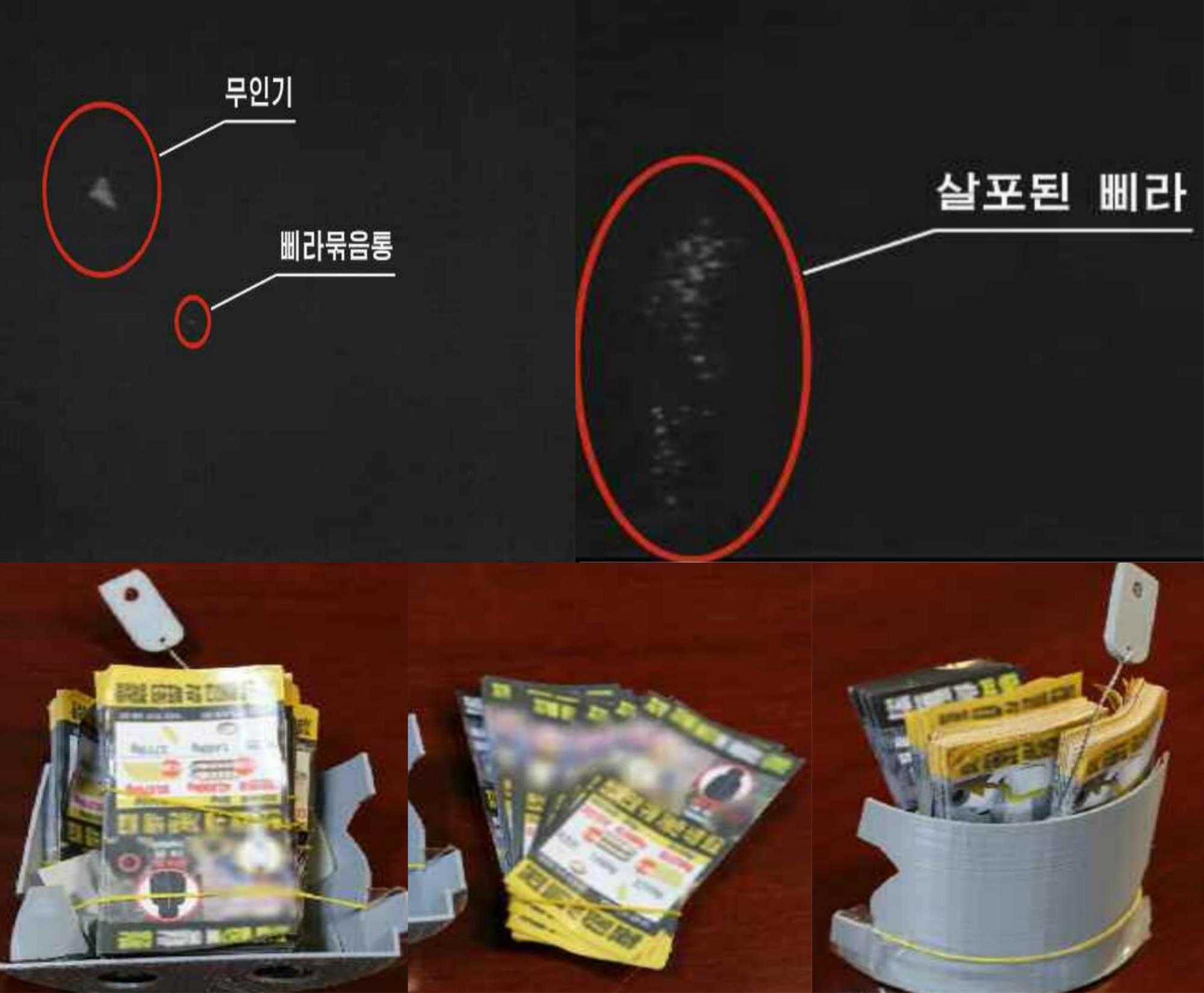
Drones / Leaflets in basket / Dispersed leaflets
A photo of the drone and leaflets that North Korea claims appeared over the Office Building of the Central
Committee of the WPK in Pyongyang on the 11th / Korean Central News Agency
Kim Yo-jong, sister of North Korean leader Kim Jong-un and Deputy Director of the Workers' Party of Korea, claimed on the 14th that the South Korean military is behind the drones sent to North Korea. In a statement via the Korean Central News Agency (KCNA), she accused, "We know the despicable South Korean military is responsible for this."
Kim Yo-jong escalated the rhetoric by involving the U.S., stating, "If the sovereignty of a nuclear-armed nation has been violated by the lackeys trained by the Americans, then the ones responsible should be held accountable."
Her harsh statement appears to be a response to South Korea’s Ministry of National Defense, which pointed out that North Korea was unable to identify the origin of the drones carrying the leaflets.
Earlier, in a statement on the 12th, Kim Yo-jong raised the possibility that civilian groups might be behind the drone activity, saying, "If the military cannot even properly identify drones that are freely crossing the border, then that’s clearly a problem."
Although she blamed the South Korean military, she did not provide evidence. Since North Korea’s claim on the 11th that a South Korean drone entered Pyongyang airspace, she has made inflammatory statements for three days, escalating threats against South Korea.
It appears Kim Yo-jong is trying to stir up anti-South Korean and anti-U.S. sentiment by blaming both for the drone incident. This may also be an attempt to highlight Korean Peninsula tensions ahead of the U.S. presidential election.
Meanwhile, the South Korean Ministry of National Defense has remained firm in its stance of "not confirming" whether the military sent drones into Pyongyang.
North Korea's Ministry of Foreign Affairs previously issued a statement on the 11th, claiming that South Korea had sent drones to Pyongyang on the 3rd, 9th, and 10th to distribute anti-North Korea leaflets.
Kim Jong-un Gathers Top Military Officials to Discuss Response to Pyongyang Drone Incident
On the 14th, Kim Jong-un convened a meeting focused on defense and security to discuss North Korea’s response to the Pyongyang drone infiltration. His appearance, just three days after North Korea accused South Korea of sending drones, is interpreted as a sign of the importance he places on addressing the incident.
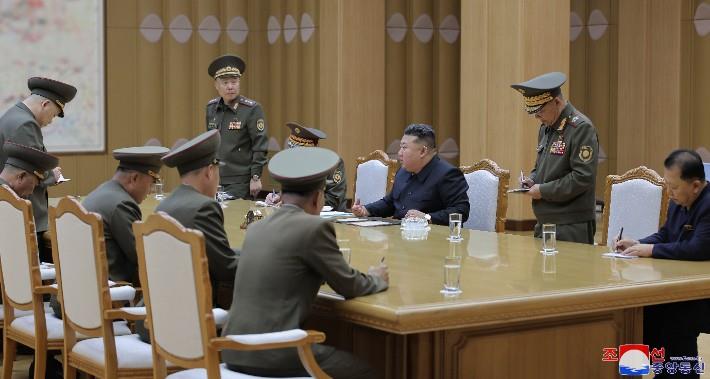
Kim Jong-un convenes a meeting on the 14th to discuss response measures to the drone incident
/ Korean Central News Agency
According to KCNA on the 15th, Ri Chang-ho, head of North Korea's Reconnaissance General Bureau, delivered an analysis on the "provocation of enemy." Other key reports were presented by Ri Yong-gil, Chief of the General Staff of the KPA, on military action plans; No Kwang-chol, Minister of Defense, on military modernization; Jo Chun-ryong, Secretary for Military Industry, on weapons production; and Ri Chang-dae, director of the Ministry of State Security, on intelligence operations.
KCNA also reported that after reviewing the General Staff’s progress and military unit readiness, Kim Jong-un outlined the "direction for military activities" and set "critical tasks for maintaining war deterrence and exercising self-defense." However, the specific tasks were not disclosed.
Additionally, Kim Jong-un reportedly expressed the "firm political and military stance" of the Party and the North Korean government, although no further details were given.
Given the officials present, discussions likely covered distributing trash balloons to the South and assessing the readiness of eight artillery brigades near the DMZ. By convening military and intelligence leaders, Kim Jong-un appears to be escalating tensions, boosting security vigilance, and using the meeting to strengthen internal discipline and regime unity.
Meanwhile, it has been confirmed that Ri Chang-ho, who attended the meeting, was recently promoted from major general (two stars) to lieutenant general (three stars).
-
PREV [Opinion]
-
NEXT [NK Focus]