

Kim Jong-un's 'Two-State Policy' and Its Delayed Legalization

Choi Kyong-hui
President of SAND Institute
On October 7–8, 2024, the 11th Session of the 14th Supreme People's Assembly convened in Pyongyang. The assembly amended parts of the socialist constitution, passed the Light Industry and Foreign Economic Laws, and discussed enforcement of the Quality Control Law and other issues. However, the details of the constitutional changes were not disclosed, which is notable given that, in the previous 10th Session held on January 15, Kim Jong-un had abolished the National Committee for the Peaceful Reunification of the Fatherland, the National Economic Cooperation Committee, and the Mount Kumgang Tourist Bureau. He had also instructed the Assembly to clearly define the political and geographical boundaries, including territory, territorial waters, and airspace, in the constitution.
Kim Jong-un, who has recently intensified the crisis in inter-Korean relations, neither attended this session nor disclosed the amended laws. In his previous speech, he framed the relationship between North and South Korea as that of two distinct states, branding South Korea as a hostile entity. He also instructed officials to legally clarify North Korea’s sovereign territories. Furthermore, he demanded the removal of language and symbols promoting unification or common identity with South Koreans from North Korean society, including terms like ‘independence,’ ‘peaceful reunification,’ and ‘great national unity.’ Kim even ordered the dismantling of the 'Monument to the Three-Point Charter for National Reunification' in Pyongyang. True to his word, the monument has since been removed.
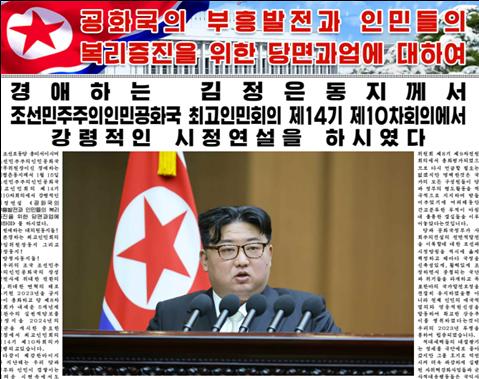
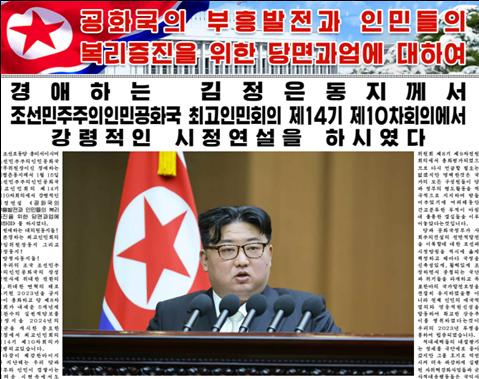
Kim Jong-un delivers a policy speech at the 10th Session of the 14th Supreme People's Assembly
in January 2024 / Rodong Sinmun
So, why is Kim Jong-un pushing for the formalization of the ‘Two-State Policy’ now, even as he distances himself from his grandfather Kim Il-sung’s reunification vision and his father Kim Jong-il’s policies? This article examines the significance of this policy in the context of inter-Korean relations and its implications for Kim Jong-un.
A Complete State Model for Lifelong Power
Since taking power, Kim Jong-un has aimed to establish North Korea as a unified, complete state rather than a divided nation, using nuclear weapons and centralized control as his main tools. He views nuclear capabilities as essential for maintaining his regime’s stability, distinguishing North Korea from the South, and asserting his authority globally. Following the successful 2017 test of the ‘Hwasong-15’ missile, Kim declared the country’s nuclear arsenal complete and promoted the ‘Our State First Principle’ to emphasize North Korea's status as a nuclear power.
In 2015, Kim introduced the ‘Paektu bloodline’ concept and established ‘Pyongyang Time’ to create a time difference with South Korea. Although he reversed this in 2018 after the inter-Korean summit, it was likely due to concerns about North Korea’s growing isolation. His efforts to cut ties with the South continued during a 2019 inspection of Mount Kumgang, where he criticized South Korean facilities as "shabby" and ordered their removal. In 2022, the Ministry of Unification confirmed that several South Korean structures, including the Hotel Haegumgang and a golf course, had been demolished.
The newly enacted laws, such as the ‘Reactionary Ideology and Culture Rejection Law’ and the ‘Pyongyang Cultural Language Protection Law,’ show North Korea tightening control over perceptions of South Korea. Shifting focus from the U.S., Kim Jong-un has intensified anti-South sentiment through education. Kim Yo Jong’s use of ‘Republic of Korea’ and the ‘Two-State Policy’ reflect this heightened stance. Externally, North Korea’s aggressive actions and severed ties further indicate Kim’s aim to create a unified state model—a family dynasty—to secure his power. With unification seen as viable only through one side’s absorption, the ‘Two-State Policy’ aligns with Kim’s strategy to consolidate power and ensure the ‘Paektu bloodlines’ rule.
Reasons for Withholding the Supreme People's Assembly’s Constitutional Amendments
Kim Jong-un had instructed the assembly to formalize the ‘Two-State Policy’ in the constitution, but he neither attended the session nor announced any amendments. One reason could be the lack of a solid framework to justify abandoning reunification. Explicitly stating the policy would require extensive revisions, potentially revealing flaws. In North Korea’s hereditary regime, legal justification is crucial for control, and any weakness could undermine legitimacy. Therefore, the amendment process may be delayed or still under consideration due to these unresolved issues.
Secondly, if North Korea officially abandons reunification, it would undermine the ‘revolutionary’ narrative that has sustained the regime for over 80 years, forcing the Workers' Party of Korea to shift its long-held stance, potentially leading to public discontent. As North Koreans become increasingly aware of South Korea’s development, abandoning reunification would likely cause widespread disappointment. In the past, some separated families could meet officially, but now such reunions occur unofficially through defections. Abandoning unification efforts without proper preparation would further disrupt North Korean society. On October 15, North Korea demolished a road connecting the two Koreas to sever ties, but state media did not report it, suggesting a reluctance to completely suppress hopes for reunification.
Thirdly, as North Korea observes the U.S. presidential election, Kim Jong-un's ‘Two-State Policy’ reveals his intention to bypass South Korea and engage directly with the U.S. He promoted this policy during a time when a potential rematch between Joe Biden and Donald Trump seemed to favor Trump. Having previously negotiated with Trump while maintaining North Korea’s nuclear capabilities, Kim indicated his preference for direct talks with the U.S. if Trump were re-elected. However, after Kamala Harris entered the race following Biden’s mid-campaign withdrawal, the political landscape shifted, leading Kim to postpone actions like legalizing the policy amid the uncertainty. Nonetheless, North Korea’s recent provocations suggest a strategy to prioritize its nuclear issue on the agenda of the incoming U.S. administration, securing its role as a negotiation partner.
Outlook
Kim Jong-un’s ‘Two-State Policy’ aims to stabilize his regime by abandoning reunification and permanently dividing the two Koreas. His strategy targets ‘gray zones’—areas of low conflict risk but high psychological pressure. While avoiding direct conflict with South Korea, North Korea is likely to escalate its nuclear capabilities and heighten tensions on the peninsula to boost its leverage with the U.S. Depending on the U.S. election results, North Korea may adjust its approach but will still prioritize U.S. relations. Provocations toward South Korea will continue as it entrenches the two-state framework.
Kim’s push for the ‘Two-State Policy’ is mainly to secure his lifelong power. This involves sealing borders with China and South Korea, restricting escape routes and defection opportunities. North Koreans face worsening economic hardship, stricter surveillance, and intensified human rights abuses. While this policy may stabilize the regime, it deepens divisions and worsens conditions for North Koreans. Despite Kim’s efforts to divide the peninsula permanently, efforts should focus on building reunification capacity and fostering North Korean aspirations for unification, as it remains a vital national goal.