

Kim Myongsung’s Inside North Korea
· North Korea Orders Traders to Import Large Quantities of Chemicals, Including Body Preservatives and Disinfectants
· Kim Jong-un Visits Flood-Affected Areas for the Third Time in an Attempt to Quell Public Discontent
· Kim Jong-un Focuses on Domestic Affairs, While Kim Yo-jong Takes Charge of Foreign Policy with Her Consecutive Speeches

Kim Myong-sung
In August, North Korea reportedly instructed its overseas trade workers to acquire substantial quantities of chemical substances like zeolite, formaldehyde, glutaraldehyde, and essential oils (such as lavender and eucalyptus), along with hydrogen peroxide (H₂O₂).
These chemicals, used as disinfectants, preservatives, deodorizers, and sterilizers, were ordered due to the rapid decomposition of thousands of bodies—victims of severe summer flooding in the northern border areas and mass deaths in concentration camps. The extreme heat accelerated decay, while inadequate cremation facilities couldn’t keep up, resulting in overwhelming odors.
A trade source in Dandong, China, familiar with the situation in Pyonganbuk-do, said, "We are buying large quantities of deodorants to eliminate odors, preservatives to prevent body decomposition, and disinfectants. Once we secure the supplies, they will be sent to the flood-affected areas of Pyonganbuk-do, Jagang-do, and Ryanggang-do." The source further explained that the damage in these regions, particularly along the Yalu River, was severe, with estimates of over 3,000 people having perished in the floods.
Despite North Korea’s denouncement of South Korean media reports as "fabrications," the flood’s impact appears far more devastating than initially anticipated. Over 2,500 deaths have been reported in Jagang-do alone, and with more bodies discovered during recovery efforts, the death toll is expected to rise, potentially reaching between 3,500 and 4,000.
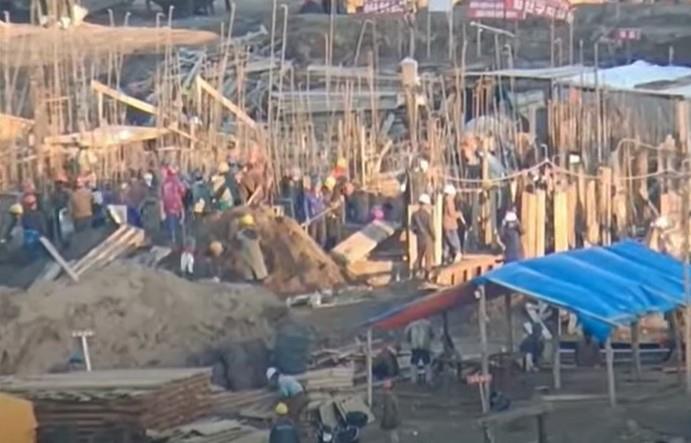
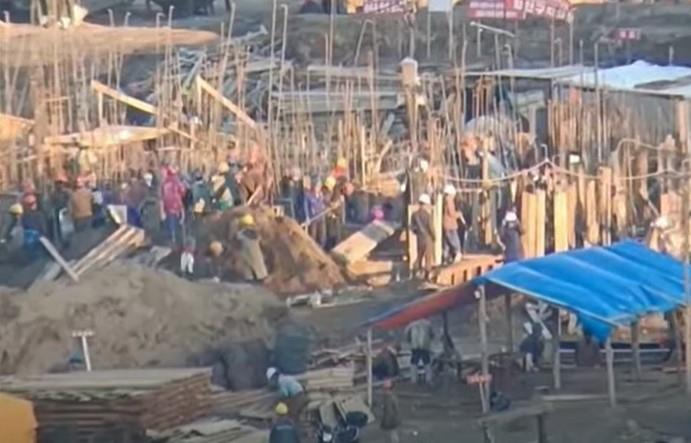
On September 20, North Korean residents work on flood recovery in Sinuiju, one of the disaster-affected areas.
/ Kang Dong-wan TV
The primary concern now is the rapid decomposition of bodies due to the heat, which is causing a foul stench and risking the spread of diseases. The source described hospitals overwhelmed by the number of bodies, with morgues overflowing, and power outages hastening decomposition. Makeshift burials and inadequate cremation facilities have led to long queues for cremations, with the smell spreading for kilometers, causing distress among nearby residents.
Meanwhile, North Korea has also seen a significant number of deaths in its concentration camps due to the record-breaking heat this year. Particularly at Chongori Concentration Camp in North Hamgyong Province, hundreds of prisoners are reported to have died from the heat, forced labor, beatings, and starvation.
A judicial source knowledgeable about Chongori explained that from June to August, during the peak of the heatwave, more than half of the camp's inmates died. The source even described how the gases from decomposing bodies caused them to burst with loud "popping" sounds in the overcrowded morgues.
Approximately 10 bodies are cremated each day at the camp, but the poor quality of coal used for cremation releases a nauseating smell that permeates the entire camp, driving both prisoners and guards to the brink of madness. The stench has even reached neighboring regions like Pungsan, causing severe odor pollution. Prisoners, who are forced to endure grueling labor in unbearable conditions, are reportedly pleading for death, saying, "Life is worse than death, please just kill me."
In an urgent response, North Korean authorities ordered trade workers to procure as many deodorizers, preservatives, and disinfectants as possible. One worker remarked, "In all my years of trade, I’ve never been asked to buy chemicals to prevent corpses from rotting. The frustration of the people affected by the floods and heatwave is growing."
Kim Jong-un Visits Flood-Affected Areas for the Third Time in an Attempt to Quell Public Discontent
North Korea’s leader, Kim Jong-un, visited the flood-hit northwestern regions again at the end of July, encouraging soldiers and youth involved in reconstruction and urging them to complete housing projects to the highest standard in the shortest time possible. This marks Kim’s third visit to the affected areas this year, which is unusual for him.
According to Rodong Sinmun, during his visit to the recovery sites in North Pyongan Province on the 29th, Kim emphasized that the top priority for the Party and government is to swiftly relieve the suffering of flood victims and restore normal production and daily life in the affected areas.
Photos released by North Korean media show new buildings under construction where homes were destroyed by the floods. However, the images also reveal a lack of heavy machinery, with construction relying heavily on manual labor. The presence of makeshift wooden stairs further underscores the shortage of materials and equipment.
This is Kim Jong-un’s eighth publicized move regarding flood recovery, seen by many as an effort to boost morale among soldiers and youth involved in reconstruction, and to ease growing discontent among residents in the affected areas.
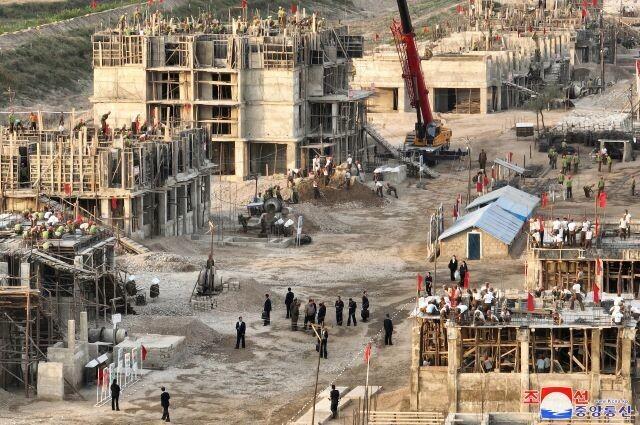
Kim Jong-un visits a flood-damaged area in North Pyongan Province on the 29th. / Korean Central News Agency
During his visit, Kim stressed the importance of ensuring adequate living conditions for those working on recovery efforts and promised "important measures" to support them.
This statement has led to speculation that the situation on the ground may be worse than previously thought, with reports of severe shortages of drinking water and the spread of diseases exacerbating the misery of the local population.
Kim’s frequent visits to flood-affected regions are also seen as efforts to present himself as a caring leader, amid rising public dissatisfaction due to inflation and economic hardship. North Korean propaganda outlets, including Rodong Sinmun, have recently downplayed Kim’s involvement in missile launches, likely to emphasize his compassionate image.
A mix of strict market controls, excessive military spending, rural housing projects, the construction of 50,000 homes in Pyongyang, and the 20×10 regional development policy has fueled inflation, causing North Korea's economy to falter.
There are reports that starving North Korean soldiers have resorted to armed raids on civilian homes. Despite the regime's efforts to tighten control by increasing the number of capital offenses from 11 to 16, public dissatisfaction is growing as the economic crisis deepens. Critics claim that Kim’s visits to flood-hit areas are mere displays, intended to pacify the public but lacking real substance.
Kim Jong-un Focuses on Domestic Affairs, While Kim Yo-jong Takes Charge of Foreign Policy with Her Consecutive Speeches
Kim Yo-jong, the Deputy Director of the WPK has recently issued several statements on foreign affairs, indicating her growing influence in this domain. While Kim Jong-un remains focused on domestic politics, Kim Yo-jong, granted considerable authority, seems to be playing a significant role in shaping North Korea’s foreign policy.
In a statement released by the Korean Central News Agency (KCNA) on the 24th of last month, Kim Yo-jong disclosed that the Air and Space Reconnaissance Bureau, an independent intelligence agency under the direct command of North Korea’s head of state, had detected an unusual object at a dock in Busan Port at 10:03:10 a.m. on the 23rd, which had been under constant surveillance. The object was identified as the U.S. Navy's Virginia-class nuclear-powered submarine Vermont (SSN-792, 7,800 tons), which had docked at Busan Port for crew rest.
Kim Yo-jong stated, "This nuclear submarine, rarely seen since its 2020 commissioning, cannot simply be viewed as on a ‘leisure cruise’ during its first appearance at the Busan Operational Base." She added that its presence highlights the U.S.’s ambition to expand its hegemonic power through malicious force, emphasizing the need to strengthen North Korea’s nuclear deterrent both qualitatively and quantitatively, without limits, to counter external threats.
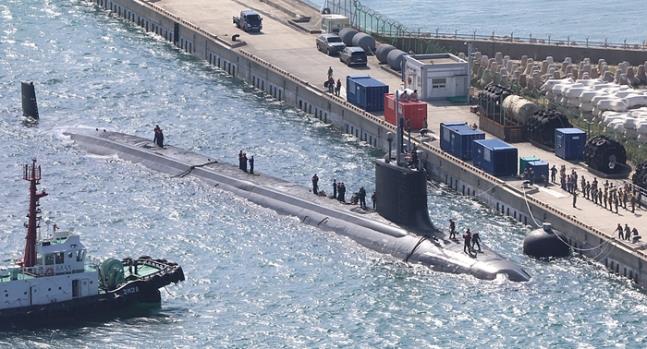
The U.S. Navy’s Virginia-class nuclear-powered submarine Vermont (SSN-792, 7,800 tons) docks at the Busan
Operational Base on the morning of the 23rd. / Yonhap News Agency
The “Air and Space Reconnaissance Bureau,” which Kim Yo-jong claimed detected the submarine, likely refers to the Malligyong-1 satellite, successfully launched into orbit last November after three failed attempts. However, South Korean Defense Minister Shin Won-sik said in February that the satellite "shows no signs of functioning and is simply orbiting without performing surveillance." North Korea has not provided satellite images or other evidence to support its claim, leading some to speculate that the information may have come from Russia.
On the 29th, Kim Yo-jong also responded sharply to comments made by Ukrainian President Volodymyr Zelenskyy at the United Nations Security Council, where he accused Russia of making North Korea and Iran accomplices in war crimes through arms deals. She dismissed his remarks as absurd and a reckless political provocation.
In a statement via KCNA, Kim Yo-jong argued that by Zelenskyy’s logic, the United States and Western nations, as the largest suppliers of weapons to Ukraine, should also be seen as key accomplices.
She criticized the U.S. for its involvement in the conflict and warned that if Zelenskyy’s actions are not stopped, a catastrophe will be unavoidable.
She went on to say that Zelenskyy, foolish enough to attempt an attack on the territory of a nuclear power, should back down before it's too late to avoid an impending disaster. She further questioned whether the U.S. and the West were truly prepared to deal with the consequences of their reckless actions, suggesting that they would struggle to handle the fallout of challenging a nuclear superpower like Russia.
-
PREV [NK Focus]
-
NEXT [Opinion]