

Rising Inflation

Cho Chung-hee
Ph.D. in North Korean Studies,
Director of Good Farmers Research Institute
1. The Current Situation
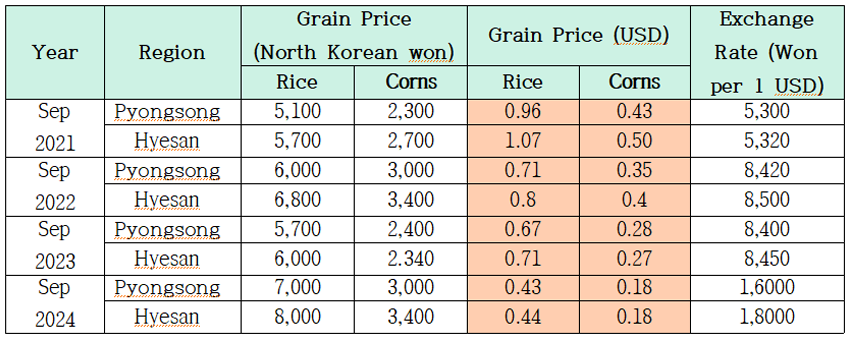
Recent reports show growing concerns over inflation in North Korean markets, with rice prices surging to 7,000 won in Pyongyang and Pyongsong and up to 8,000 won in inland Ryanggang and North Hamgyong provinces—marking the highest increase in recent years.
As of September 2024, North Korea's Central Bank set the official exchange rate at 9,000 won per U.S. dollar, while the market rate is 18,000 won. Table 1 outlines the fluctuations in grain prices in Pyongsong and Hyesan since 2021.
As the data shows, while grain prices in North Korean won have risen steeply, prices in U.S. dollars have followed a different trend. Since most North Koreans don't engage in dollar-based transactions, the sharp increase in local grain prices is alarming. Under hyperinflation, citizens face skyrocketing prices without any rise in their real income, exacerbating their hardships.
Table 1: Changes in Grain Prices in Pyongsong and Hyesan Regions as of September
2. Identifying the Problem
Inflation is generally defined as the consistent and proportional rise in prices over a period or the persistent decline in a currency's value. In North Korea, several factors are contributing to the depreciation of the won and the rise of the dollar. These factors are not merely linked to a one-time price increase but are part of a broader inflationary trend. So, what are the main causes?
1) Rising Dollar Exchange Rate
One major cause of the rising exchange rate is the impact of global financial trends. The dollar has been strengthening in markets worldwide, including in South Korea. During the COVID-19 lockdown, when North Korea was isolated, the dollar dropped to 5,300 won, and the price of rice nearly matched one dollar at 0.96 USD per kilogram. However, with the lifting of lockdowns, North Korea has felt the effects of the rising dollar.
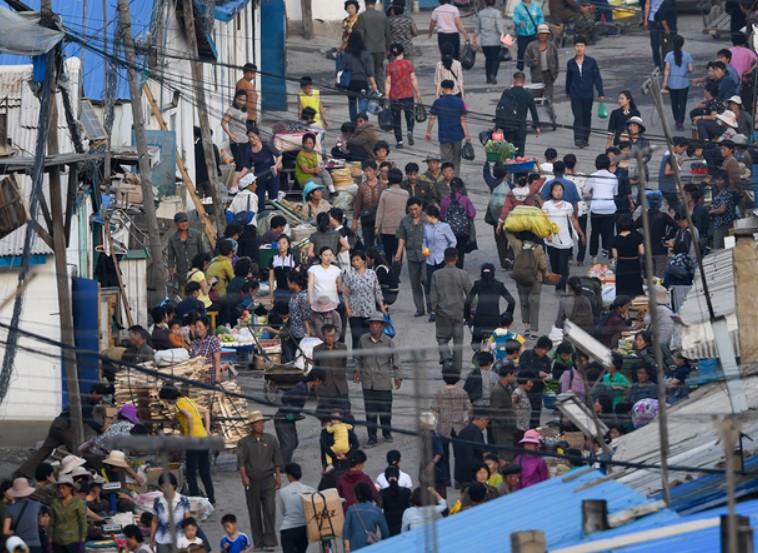
A Glimpse of Hyesan Market in Ryanggang Province, North Korea / Kang Dong-wan, Professor at Dong-A University
Another contributing factor is North Korea's limited dollar reserves. The severe economic hardships that have plagued the country since the mid-1990s have made it difficult for North Korea to accumulate significant foreign currency reserves.
Furthermore, North Korea’s rigid financial system and strict controls on the flow of dollars are also a factor. The government tightly regulates dollar exchanges through various state agencies, including the Central Bank and judicial institutions, which has further restricted the dollar's circulation.
Finally, the reckless printing of money by the central bank has added to the problem. Instead of providing materials for construction projects, the government has opted to print more money, which has flooded the market and contributed to inflation.
Note: A recent report from a resident in Pyongsong where North Korea’s currency factory is located, indicates that the factory has been running at full capacity for the past year, flooding the market with new currency. This rapid production increases the risk of hyperinflation. Most North Koreans, who are part of the low-income class, consider holding foreign currencies like the dollar or yuan a luxury and primarily keep their assets in North Korean won. As a result, the devaluation of the won further exacerbates their financial struggles. With rising prices, people save less, and businesses face greater difficulties in attracting investment.
2) Rising Prices of Essential Goods
North Korea's recent inflation stems from a decline in overall supply, as the government and banks have exhausted their ability to raise funds in the wake of COVID-19, while struggling to meet growing demands. First, the North Korean government is pouring vast resources into military preparations.
Second, Kim Jong-un and his regime have recklessly pursued consumption-driven economic policies to showcase achievements that help maintain the regime. Despite a lack of resources, they are pressing ahead with projects like the 20×10 regional development policy, rural revitalization initiatives, and building 50,000 housing units in Pyongyang after COVID-19. Additionally, the financial burden has worsened due to flood damage in the Yalu River region. With skyrocketing fiscal demands and limited capacity to generate funds, the government has resorted to excessive money printing to cover the gap.
Third, the supply of essential goods like rice, corn, and flour has sharply decreased. Economic uncertainties in North Korea have caused price distortions in these vital markets, crucial for residents' survival. These distortions, along with wealth redistribution, have fueled social unrest and disrupted resource allocation, further endangering survival. This is North Korea's current reality.
3. Proposed Solutions
To overcome the current crisis, North Korea must revitalize its market by granting individuals the freedom to pursue personal economic gains. By allowing residents to engage in trade and cooperation for their benefit, the material wealth of both the government and the people can improve.
In response to the soaring demand for essential goods, such as grains, the country must increase supply by striking a balance between domestic production and imports. Given the foreign currency shortage, combining state-regulated trade with private smuggling may be the fastest solution.
Second, institutional reforms are essential. Historically, communities with rigid systems have struggled to progress beyond basic lifestyles, with many fading away after maintaining only a nominal existence. Institutions are crucial not just for social behavior and human relations, but also for economic growth. North Korea's lack of economic development and the long-term poverty its people endure are closely tied to the rigidity of its institutions.
A self-reliant economy should be built around the population's demand and production capacity, with price increases occurring naturally as a result. The belief that cutting off external connections and raising prices due to supply shortages will stimulate the economy is a flawed reversal of cause and effect.
Excessive price increases hurt both businesses and consumers, ultimately suppressing demand and stalling economic growth. It is crucial to recognize that some of North Korea's policies are worsening the situation, rather than addressing the root causes of its economic challenges.