

Kim Myongsung’s Inside North Korea
· Flooding Paralyzes North Korea's Arms Production Hub in Jagang Province, Disrupting Supplies to Russia
· North Korea Spends $10 Million on Watches for Kim Jong-un’s Gift-Giving Strategy in the First Half of This Year
· Strained North Korea-China Relations on 75th Anniversary of Diplomatic Ties: North Korea Bans Chinese Drama Praised by Kim Jong-il

Kim Myong-sung
- Arms factories in tunnels crippled by floods
- Landslides cut off roads; communication lines remain down
- Hundreds of border mines lost near the Amnok River
- Significant damage to border fences and surveillance cameras
Jagang Province, North Korea's key military production hub, has been severely affected by late July flooding, disrupting military goods production. Reports also indicate damage to barbed wire fences and surveillance cameras along the North Korea-China border, with some mines being washed away. Some suggest that Kim Jong-un's recent unveiling of new artillery and suicide drones may be a strategy to show that North Korea can still produce military supplies for Russia despite these setbacks.
On September 2, the National Intelligence Service (NIS) commented on the flooding in Jagang Province, stating, "This area is densely packed with military factories, and we are closely monitoring for potential damage, disruptions in military supply production, and impacts on North Korea-Russia arms trade." The underground tunnel factories have been flooded and are currently non-operational.
A source familiar with the situation in North Korea reported, "The mountainous terrain of Jagang Province has experienced several large-scale landslides from the recent downpour, resulting in flooded tunnels and cut-off railways and roads."
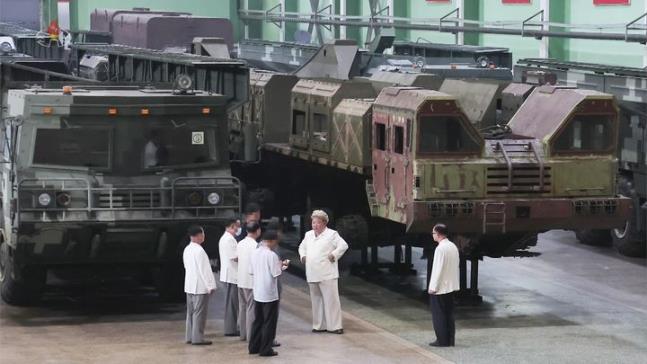
Kim Jong-un touring major military factories in August / Korean Central Television
Jagang Province is largely mountainous, featuring a well-developed railway network and rich underground resources crucial for weapon production. Its location near the Chinese border allows for easier importation of materials needed for military development, establishing the province as a key center for North Korea's military industry. Numerous military factories are hidden in tunnels throughout the region, producing missiles, artillery shells, launchers, rifles, machine guns, helmets, and water canteens. Since North Korea began exporting significant amounts of artillery shells, ammunition, and missiles to Russia last year, these factories have reportedly been operating at much higher levels.
However, the recent flooding has submerged both the military production equipment and materials inside these tunnels, including sensitive items like gunpowder, which are likely now unusable, according to sources. Due to the extent of the damage in Jagang Province, recovery is expected to take several months rather than just a few. It seems that Kim Jong-un's decision to dismiss the Party Secretary of Jagang Province was a direct reaction to the failure to protect these key military facilities from flooding.
The severe damage to Jagang Province’s military factories could significantly hinder North Korea’s ability to produce weapons for Russia. With the ongoing conflict in Ukraine straining Russia's military production, North Korea has been stepping in to fill the gap. However, the flooding in this critical production area has raised concerns. Observers suggest Kim Jong-un has avoided visiting Jagang Province due to the severe damage. Additionally, North Korea’s recent display of new drones and rocket launchers is seen by analysts as an effort to show that its military production capabilities for Russia remain intact despite the floods.
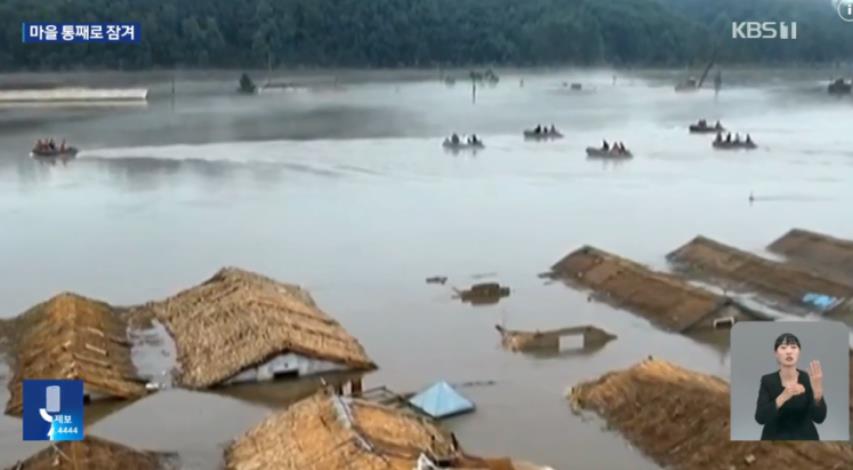
A village in Jagang Province, North Korea, submerged after August floods / KBS
Meanwhile, many barbed wire fences along the Amnok River, intended to prevent defections, have been damaged, and numerous mines have been washed away. A North Korean source reported that mines planted along the 20th Guard Brigade's patrol routes in Sinuiju City and Uiju County, North Pyongan Province, were swept away by the flooding. These mines, along with sediment, flowed into residential and farming areas, prompting recovery efforts by the authorities. During the recovery process, an explosion reportedly occurred, resulting in multiple casualties.
The recent flooding along the Amnok River has impacted North Pyongan, Jagang, and Ryanggang provinces, with reports of 1,100 to 1,500 people dead or missing. Official North Korean sources state that the number of flood victims is around 15,400. There have also been reports of looting amid the chaos following the disaster.
North Korea Spends $10 Million on Watches for Kim Jong-un’s Gift-Giving Strategy in the First Half of This Year
- Imports of luxury goods like Cognac have surged 200-fold compared to during the COVID-19 lockdown.
- Imports of cosmetics have risen more than 20 times
Despite severe economic difficulties and flood damage last year, North Korea imported $37.94 million (about 5.05 billion KRW) worth of goods, including $10 million on watches for Kim Jong-un's gift-giving, in the first half of this year. Critics claim that, despite sanctions and economic struggles, North Korea continues to spend foreign currency on luxury items for Kim Jong-un’s family and the elite, using illicit means to bypass restrictions.
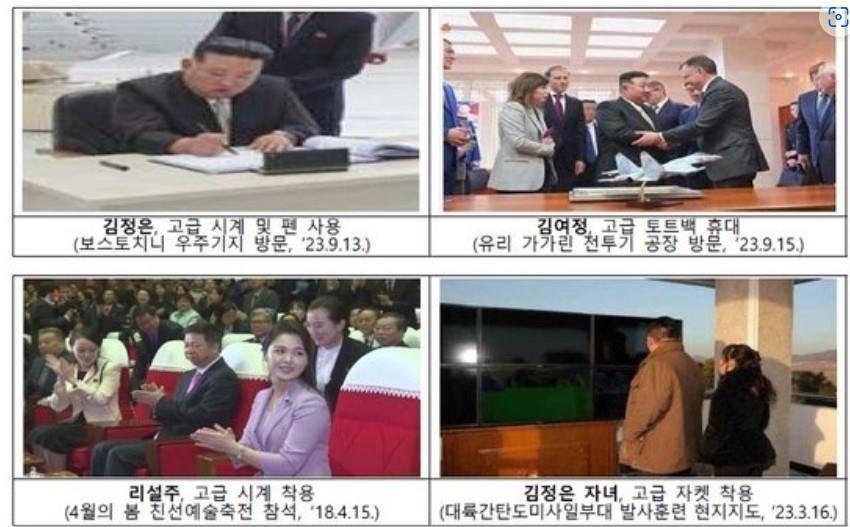
Signs of luxury goods being used by Kim Jong-un’s family / Ministry of Unification
On the 20th of last month, an analysis of Chinese customs data by the office of Yoon Sang-hyun, a member of the People Power Party (PPP) on the Foreign Affairs and Unification Committee, showed that North Korea's imports from China steadily increased between January and June after the lifting of the COVID-19 lockdown.
Breaking down the categories, liquor imports jumped dramatically from $20,000 to $3.93 million, marking a 200-fold increase compared to 2021 during the COVID-19 lockdown. Similarly, cosmetics imports soared from around $550,000 to $11.8 million in the first half of this year, a more than 20-fold increase.
Imports of leather goods surged from $60,000 to $4.03 million, a more than 60-fold increase. For watches, often used in Kim Jong-un's "gift strategies," the import value in the first half of this year reached $10.72 million, surpassing last year's total of $9.43 million.
Since its first nuclear test in October 2006, North Korea has been banned from buying high-end luxury goods under the UNSC sanctions. However, it continues to obtain these items through covert means. It was also recently revealed that North Korea imported 24 white horses from Russia last month.
Yoon pointed out that the sharp rise in imports of alcohol, cosmetics, and watches indicates Kim Jong-un is using these luxury goods for his gift-giving strategy to the Party, Military, and State. He also mentioned that the amount of luxury goods being smuggled in, bypassing official statistics, is likely significant.
Yoon further warned, “The growing closeness between North Korea and Russia, evident through summits and military cooperation, could undermine the sanctions regime and create more channels for smuggling luxury goods.” He urged for “stronger collaboration with the international community to tighten sanctions on North Korea.”
Strained North Korea-China Relations on 75th Anniversary of Diplomatic Ties: North Korea Bans Chinese Drama Praised by Kim Jong-il
North Korea has reportedly banned Chinese films and dramas, labeling them as "impure recordings," including one that was highly praised by Kim Jong-il. As this year marks the 75th anniversary of their diplomatic relations, these actions suggest the relationship between North Korea and China may be moving toward long-term tension.

Poster for "The Love Eterne" / Baidu
According to an August 28 report by Radio Free Asia (RFA), North Korean authorities recently issued a ban on viewing Chinese content, including movies and dramas, indicating a tightening of restrictions on foreign media.
A source from South Hamgyong Province told RFA that the list, issued from late May to early June, included dozens of South Korean songs and movies, such as a North Korean concert song by South Korean singer Kim Yon-ja, as well as TV series and films from India, Russia, and China, all labeled as "impure recordings."
Among the banned Chinese videos are films and dramas like "The Love Eterne," "The Charm of a Man," "The Man Who Came to Shanghai," "Martial Arts," and "Detective Police," which were produced in Hong Kong or mainland China. Notably, "The Love Eterne," a Chinese adaptation of "Romeo and Juliet," was staged by North Korea’s renowned Pibada Opera Troupe under Kim Jong-il's direction in 2010 and toured extensively in North Korea and China, becoming highly popular. The designation of such a once-celebrated work as "impure material" highlights the current frosty state of North Korea-China relations.
As North Korea and China mark the 75th anniversary of their diplomatic relations this year, there are several signs of growing tensions in various areas. Recently, North Korea raised concerns with the United Nations' International Telecommunication Union (ITU) over China's plans to set up radio stations near the border.
On July 24, North Korea emailed the ITU, stating that China's plan to install 17 base stations, including one in Dandong, could cause "serious interference" and opposed their installation near the border. North Korea argued that China did not seek prior coordination, which they claimed violated ITU guidelines, even though such coordination is only recommended, not required, by the ITU.
Analysts believe North Korea’s decision to ban Chinese cultural content reflects its intent to block external information, even from its ally China. In a further move to distance itself from China, North Korea switched the broadcast of Korean Central Television from a Chinese satellite to a Russian one in July. Earlier in May, China removed a "footprint plaque" that commemorated Kim Jong-un's 2018 visit to Dalian, where he had a walk with Chinese President Xi Jinping to strengthen their relationship. Additionally, early last month, China reportedly demanded that all North Korean workers, a significant source of foreign currency for North Korea, be sent back to their home country.
In response to the China-Japan-South Korea Trilateral Summit in Seoul on May 27, which led to a joint declaration mentioning "denuclearization of the Korean Peninsula," North Korea issued an unusually harsh statement. On the same day, it launched the Reconnaissance Satellite No. 2, signaling its displeasure. Additionally, the Chinese ambassador to North Korea was notably absent from the "Victory Day" (Korean War Armistice Agreement Anniversary) event in Pyongyang on July 27.
In late July, after floods affected areas along the North Korea-China border, including North Pyongan, Jagang, and Ryanggang provinces in North Korea, China offered assistance, which North Korea reportedly declined. Experts believe this tense atmosphere between the two nations is likely to continue for the foreseeable future.
-
PREV [Issue Brief]
-
NEXT [SAND Exclusive]