


North Korea's Policy Toward South Korea: Trends from July and August 2024
- Kim Jong-un's "Two Hostile States" and the DPRK -

Lee Seung-hyun
Research Fellow at SAND Institute
Ph.D. in Public Administration
drharacearthur@gmail.com
On December 30, 2023, at the fifth session of the Workers' Party of Korea Plenary Meeting, Kim Jong-un declared that inter-Korean relations were no longer fraternal but had become those of two hostile states. He stated that unification with South Korea was unattainable. Kim emphasized that North-South ties had solidified as adversarial and likened the relationship to two warring states. He noted that South Korea’s policies of 'unification by absorption' and 'system unification' starkly contrasted with North Korea’s vision of a “two-state system” and “one Korea policy,” making unification impossible.
This announcement might suggest that North Korea has abandoned the goal of reunifying the Korean Peninsula. Following this, North Korea's actions, such as building barriers and maintaining hostile policies towards South Korea, may seem to endorse a permanent separation. However, assuming North Korea has completely forsaken the goal of reunification would be a grave policy mistake, as indicated by Kim’s detailed explanation of the hostile relationship between the two Koreas.
Kim Jong-un’s remarks on the hostile nature of inter-Korean relations included warnings that the Military Demarcation Line (MDL), where large military forces confront each other, could easily become a flashpoint for conflict. He implied that this situation might not just cement the armistice line as a permanent border but could lead to escalated military actions aimed at occupying South Korea. Despite this, North Korea’s recent policy actions suggest a strategic shift in military planning.
Confident in its nuclear arsenal, delivery systems, rockets, and cyber capabilities, North Korea seems poised to use more sophisticated methods to minimize physical destruction while targeting South Korea. This strategy aligns with recent efforts, such as constructing barriers near the armistice line and Kim’s remarks at the new tactical ballistic missile handover ceremony, emphasizing readiness for frontline units.
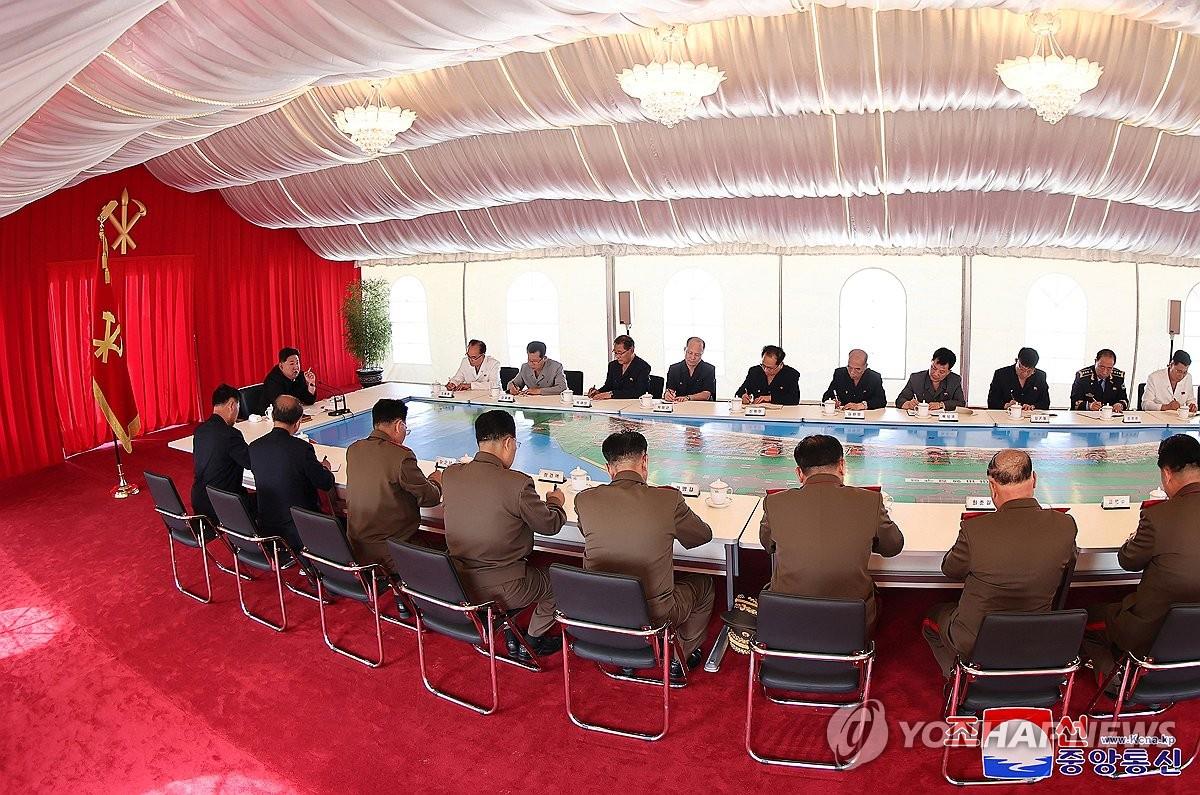
On July 16, Kim Jong-un inspected the Wonsan-Kalma coastal tourism zone with key officials,highlighting his focus on
domestic development / KCNA, Yonhap News Agency
In July, alongside these military actions, Kim Yo-jong, Deputy Director of the WPK, and the military issued continuous hostile statements against South Korea. They criticized and responded to the South Korean military's resumption of firing exercises in border areas and the distribution of anti-North Korea leaflets by South Korean groups. The North Korean military, through a Ministry of National Defence spokesperson, expressed strong opposition to the adoption of the 'U.S.-ROK Joint Statement on Nuclear Deterrence and Nuclear Operations Guidelines' at the NATO summit, claiming it indicated a “clear intent of nuclear confrontation” and “preparation for a nuclear war targeting North Korea.”
Despite these aggressive stances, Kim Jong-un also focused on domestic issues, emphasizing his role as a leader attentive to the people’s welfare. He inspected various construction sites, such as those in Samjiyon City and the Wonsan-Kalma District, and provided on-site guidance in Sinuiju and Uiju County. His focus on internal development, along with his prominent display during the 10th Plenary Meeting of the 8th Central Committee of the WPK and the commemoration of Kim Il-sung’s death on July 8, suggests a deliberate effort to idolize Kim Jong-un.
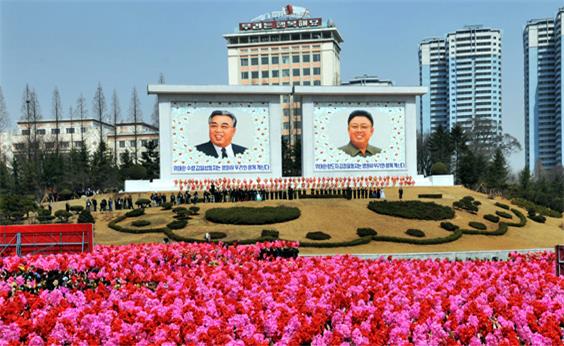
Throughout North Korea, murals with a sun emblem and the phrase "Suryong and General will be with us forever" can be seen.
/ by Rodong Sinmun
Moreover, it appears that Kim Yo-jong oversees policies toward South Korea and military affairs, Foreign Minister Choe Son-hui handles international relations, and Premier Kim Tok-hun manages internal affairs, indicating a new order of governance in North Korea, with Kim Jong-un at the helm.
The ‘Reactionary Ideology and Culture Rejection Law’ has increased public executions and tightened control over the population, with more frequent mobilizations, ideological education, and self-criticism sessions. The heightened control over the Socialist Women's Union of Korea has limited housewives' economic activities, and crackdowns on market activities by the Central Committee of the Workers' Party of Korea have threatened the ‘Jangmadang,’ a key component of North Korea's economy. From July 25 to 29, floods in the Yalu River basin caused significant casualties and damage in North Pyongan Province, Jagang Province, and Ryanggang Province. Although South Korea offered humanitarian aid, Kim Jong-un declined, opting instead to manage disaster recovery internally.
His visit to flood-affected areas in Uiju County on August 8-9 and the subsequent measures announced underscore his commitment to self-reliance, even at the expense of rejecting international aid. In reality, North Korea deployed soldiers and shock troops from local industrial plant construction in Kimhyongjik County to the flood-affected areas, but they focused on restoring historical sites and embankments rather than residents' homes.
North Korea is also bolstering its diplomatic ties with Russia. President Vladimir Putin's visit on June 19 and the subsequent North Korean military education delegation to Russia in July highlight the growing military cooperation between the two nations. While China has not directly commented on this closer North Korea-Russia relationship, it has shown discomfort by requesting the repatriation of North Korean workers. North Korea likely sees more tangible benefits in military cooperation with Russia than in the calculated support from China, leading to a stronger partnership with Russia.
On August 5, North Korean state media reported that Kim Yo-jong bowed slightly to Kim Ju-ae during a handover ceremony for a new tactical ballistic missile launcher, sparking speculation about Kim Ju-ae as a potential successor. However, it is premature to consider this a definitive sign of succession. The bow could reflect protocol and rank rather than a clear indication of succession. Nevertheless, Kim Ju-ae’s continued public appearances, especially in military contexts, suggest that she might be groomed for a significant role, potentially overseeing inter-Korean and military affairs, similar to Kim Yo-jong.
In conclusion, North Korea's activities in July and August 2024 indicate a structured approach to governance centered around Kim Jong-un. Kim Yo-jong manages policies toward South Korea and military affairs, aligning with the public appearances of Kim Ju-ae. The regime is promoting Kim Jong-un's idolization, reinforced by his declaration of ‘hostile relations between two states.’ They are tightening control over residents through the ‘Reactionary Ideology and Culture Rejection Law’ and organizations like the Socialist Women's Union of Korea. Additionally, they are rejecting international aid for flood damage to maintain social control and emphasize Kim Jong-un's image as a benevolent leader. North Korea is also likely to continue strengthening its relationship with Russia to bypass sanctions through military cooperation. Overall, North Korea maintains its hostile policy toward South Korea, justifies provocations, suppresses public dissent through ideological reinforcement, and stabilizes the regime by idolizing Kim Jong-un.