

The Third Plenary Session of the 20th Communist Party of China (CPC) and Its Significance
Lee Tae-hwan
Senior Fellow at The Sejong Institute
The 3rd Plenary Session of the 20th Communist Party of China (CPC), held from July 15 to 18, drew significant attention. This followed an April 30 Politburo meeting, where it was decided to hold the session in July in Beijing to address economic difficulties. The meeting was notable because it was held nine months later than usual, despite its importance in outlining the economic direction for Xi Jinping's third term. It also attracted attention as it could provide insights into China's future economic, social, and foreign policies under Xi's leadership.
The session approved the "Decision of the Central Committee on Further Deepening Comprehensive Reform and Promoting Chinese-Style Modernization." This article will examine the details, features, and significance of this decision.
This decision includes 60 articles with over 300 reform measures focusing on systems, mechanisms, and institutions. Key points include the importance of comprehensive reforms, reforms driven by the economic system, and enhancing party leadership in reform. The emphasis is on a Chinese model, solidifying the party-state system rather than adopting a Western approach.
Second, the session addressed measures for international cooperation and attracting foreign investment. Amid global instability, foreign investment in China has drastically decreased, and credit ratings have been downgraded. In 2023, foreign direct investment in China amounted to $33 billion, just a tenth of the $344.1 billion in 2021. There are significant concerns that China's economic recovery may fall short of expectations. Achieving China's 5% economic growth target this year depends on both domestic recovery and the extent of China's openness to international cooperation.

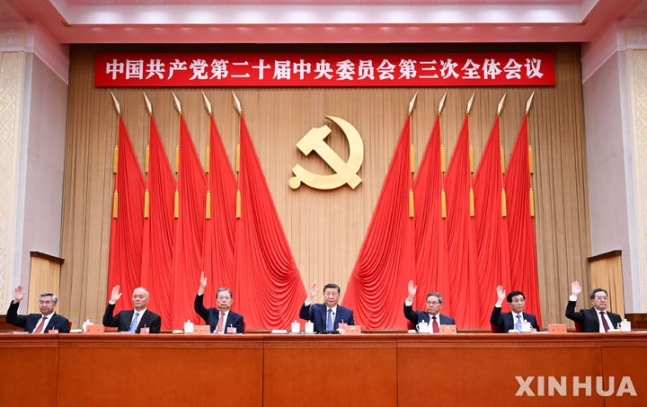
On July 18, in Beijing, the closing ceremony of the Third Plenary Session of the 20th CPC was held.
Top Chinese leaders are shown passing a resolution by a show of hands. / July 19, 2024/Xinhua
At the Two Sessions in March, "openness and international cooperation" were emphasized. The decision at the 3rd Plenary Session to deepen market reforms and reform the foreign investment and overseas investment management systems is significant but represents tactical adjustments within the party-state system rather than strategic changes.
Third, the session stressed the importance of "new quality productive forces" led by high-tech industries. It aims to strengthen the state's role in key strategic sectors such as science and technology, focusing resources on areas like next-generation IT, AI, aerospace, new energy, new materials, advanced equipment, biotechnology, pharmaceuticals, and quantum science and technology.
Fourth, plans were introduced to enact the Private Economy Promotion Law and Financial Law. These laws aim to create a favorable environment and provide more opportunities for the non-public sector economy.
Fifth, the session outlined long-term goals, aiming to complete the proposed reform tasks by 2029, the 80th anniversary of the People's Republic of China, and establish a high-level socialist market economy system by 2035.
Sixth, the session highlighted the need to promote positive interactions between security and new productive forces and to modernize the national security system.
In conclusion, the policies and measures discussed at the session focus on medium- to long-term tasks and goals. The success of these reforms hinges on the effective implementation of specific and flexible plans.
The 75th Anniversary of North Korea-China Diplomatic Relations and the Outlook for Their Relationship
If the recent economic reforms don’t produce results and the slowdown continues, China’s ability to exert geopolitical influence through aid and loans might be compromised. The state of China’s economy could also impact its economic cooperation with North Korea. Given the sanctions and considering its relations with the US, Japan, and European countries, China will find it challenging to expand aid or trade with North Korea. This reluctance is also why China hasn’t agreed to extend UN sanctions against North Korea.
During Xi Jinping's tenure, North Korea-China relations have been managed within the broader framework of US-China and multilateral relations rather than through traditional bilateral ties. The five North Korea-China summits in 2018 and 2019, surrounding the North Korea-US summits, reflect considerations of regional dynamics between the US and China.
Marking the 75th anniversary of diplomatic relations, North Korea and China are accelerating cooperation and high-level exchanges. In April, Zhao Leji, Chairman of the National People's Congress Standing Committee, visited North Korea, indicating a possible North Korea-China summit this year.
However, some believe China is distancing itself from North Korea, avoiding a US-South Korea-Japan vs. China-Russia-North Korea bloc formation. The Chinese delegation emphasized a mutually beneficial relationship and 'protecting common interests' rather than strong support for North Korea, contrasting with the anti-American or anti-Western rhetoric at the Xi Jinping-Vladimir Putin summit.
The strengthening of Russia-North Korea cooperation has emerged as a key factor in North Korea-China relations. After Putin's visit to North Korea in June, where a mutual defense treaty was signed, China has shown indifference or discomfort. Chinese Foreign Ministry spokesperson Lin Jian stated that the cooperation between Russia and North Korea is an issue between two sovereign states and refused to comment on the new agreement. This contrasts with the emphasis on unlimited cooperation between China and Russia when Putin visited China in May, indicating China’s concerns about competing with Russia for influence over North Korea.
Facing economic challenges, China aims to maintain influence over both North and South Korea. It adopts a competitive and restrained approach with the US and Japan rather than direct confrontation. China is restoring military dialogue channels with the US to avoid conflicts and is adopting a wait-and-see approach until the US presidential election.
After Putin's visit to China in May, Xi Jinping attended the South Korea-China-Japan summit to boost economic cooperation and counter the growing military ties between South Korea, the US, and Japan. To maintain friendly relations with EU countries amid trade tensions, Xi toured Europe, visiting France, Hungary, and Romania. In July, when the Italian Prime Minister led a large delegation to China, they promised cooperation and investment in the automotive and AI sectors, reflecting a conciliatory stance.
Given China’s economic situation and its comprehensive approach to international cooperation, significant expansion of economic and military exchanges with North Korea or a South Korea-US-Japan vs. North Korea-China-Russia bloc confrontation is unlikely this year. After the US presidential election, US-China relations may be readjusted, potentially leading to a realignment of North Korea-China relations.
-
PREV [NK Focus]
-
NEXT [NK Focus]