

Rising Threat from North Korean Trash Balloons:
A New Role for the United Front Department?

Lee Seung-hyun
Research Fellow at SAND Institute
From May to July, North Korea floated around 3,600 trash balloons into South Korea in retaliation against leaflets sent by defector groups. Despite our military's countermeasures, including propaganda broadcasts, North Korea flew over 1,500 more trash balloons on just the 24th alone.
The frequency of these balloon drops has increased, and they have become more dangerous. Now equipped with timers and detonators, some balloons have landed inside the Yongsan presidential office complex for the first time.
The National Intelligence Service (NIS) reported on the 29th that North Korea has sent a total of around 3,600 trash balloons in 10 separate incidents. Initially, they sent waste, mainly manure or discarded plastic, but later switched to paper and garbage to confuse our response.
Kim Yo-jong, the Deputy Director of the Workers' Party of Korea (WPK) and sister of North Korean leader Kim Jong-un, has issued five statements regarding the trash balloons. The NIS considers this an unusual move, marking the most statements made on a single issue in a short period.
It’s anticipated that North Korea will modify their tactics by targeting densely populated areas or major security facilities with these trash balloons. They might also enclose suspicious white powder and carry out other provocations, such as strikes near the Northern Limit Line (NLL).

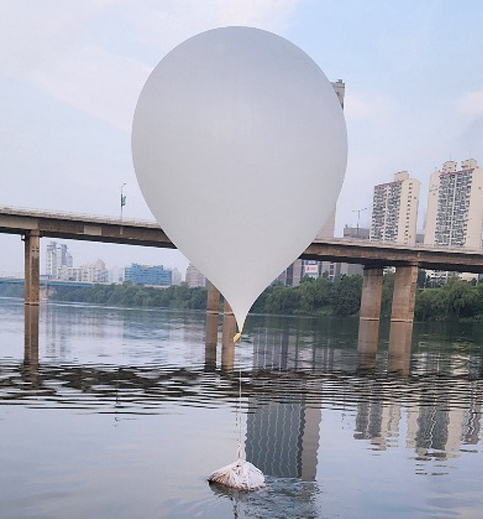
A trash balloon sent by North Korea, discovered near Jamsil Bridge on the Hangang River
in Seoul, on the morning of June 9th. / JTBC
The United Front Department (UFD) of the Workers' Party of Korea is believed to be behind these trash balloon launches. Recently renamed the "10th Bureau of the WPK Central Committee," this organization was restructured to focus on overtly hostile activities against South Korea.
Earlier this year, Kim Jong-un declared inter-Korean relations to be hostile and ordered a reorganization of related departments. Consequently, the UFD’s role in inter-Korean dialogue was abolished, and it was transformed into an entity responsible for aggressive operations like the trash balloon launches.
It is speculated that the UFD planned the trash balloon operations, with execution by the North Korean Army's Reconnaissance General Bureau and propaganda handled by the WPK's Propaganda and Agitation Department.
Established in 1978, the UFD is the North Korean Workers' Party's organization responsible for inter-Korean negotiations, economic cooperation, psychological warfare, recruiting pro-North figures, and instigating internal conflicts.
This department oversees various organizations like the National Committee for the Peaceful Reunification of the Fatherland and the Korean Asia-Pacific Peace Committee, directing operations against the South. The UFD also played a leading role in the inter-Korean and US-North Korea summits in 2018 and 2019.
Following the failure of the Hanoi summit, the UFD underwent scrutiny and purges, leading to its downsizing and reorganization. Earlier this year, Kim Jong-un redefined inter-Korean relations as hostile, removing the concept of 'unification,' and renamed the UFD as the "10th Bureau of the WPK Central Committee.“
Known as the "Bureau of the Enemy," this name reflects its role in enhancing aggressive operations and psychological warfare against the South.
The recent trash balloon launches are seen as attempts to destabilize South Korea by dividing public opinion, isolating defectors, and creating confusion in South Korea’s policies towards the North.
However, if there is significant backlash against the trash balloons both domestically and internationally, the Bureau could be labeled a "garbage department." North Korean authorities likely refrain from informing their citizens about the balloons to avoid internal criticism.
There are also speculations that North Korea is using these balloons to collect wind data for targeting major South Korean facilities. Concerns have been raised that North Korea might escalate provocations by attacking the launch points of South Korean balloons.
The US and South Korean defense ministers' strong demand on the 28th for North Korea to stop the trash balloon launches is seen as a warning against North Korea’s aggressive actions.