

Kim Myongsung’s Inside North Korea
· Kim Jong-un Visits Military Factory Post-Plenary, Signaling Urgency in Arms Exports?
· North Korea Falsely Claims Success Amid Consecutive Missile Failures
· North Korea Debuts 'Kim Jong-un Badge' as Leader Solidifies Unique Status on 40th Birthday

Kim Myongsung
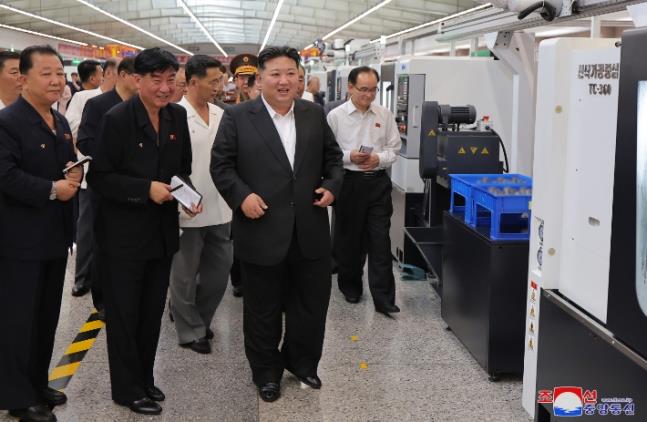
North Korean leader Kim Jong-un, after the Workers' Party of Korea (WPK) Plenary Meeting, visited a defense industry factory with officials, emphasizing it as a model for all economic sectors. This visit appears to justify defense industry development despite economic challenges and to expedite weapon production for export to Russia.
KCNA detailed that Kim Jong-un inspected a defense industry facility critical to enhancing the nation's defense capabilities. He reviewed advanced unmanned production processes noted for their high levels of intelligence, precision, and performance.
They conveyed Kim Jong-un's assertion that the level of modernization achieved by the defense industry sets a benchmark for all sectors of the national economy. He called for continuous updates to production command systems and the rapid dissemination of these advancements across all economic areas.
This assessment indicates that North Korea is fully leveraging its capabilities to maintain munitions factories at full operational capacity despite comprehensive international sanctions. The Rodong Sinmun's report highlighted that the defense factory exceeded its production targets for the first half of the year, with officials recognizing the rapid progress in the defense sector. The "military economy" is seen as a key area for North Korea to earn foreign currency, as well as secure food, energy, and critical weapon technologies amid international sanctions.
Kim Jong-un's tour also included visits to significant machinery factories and medical equipment production facilities. This follow-up visit is viewed as an extension of the Plenary Meeting, which focused on economic achievements and future goals.
North Korea previously disclosed the outcomes of the 10th Plenary Meeting of the 8th Central Committee of the Workers' Party, chaired by Kim Jong-un from June 28 to July 1, focusing on people's livelihoods and internal system management. North Korean media reported that Kim Jong-un expressed contentment with the results of the country's economic policies, noting an apparent economic upturn. However, acknowledging the mid-term evaluation, he highlighted significant obstacles and challenges in national and social affairs, along with various deviations and defects within the people's economy, reflecting North Korea's tough economic reality.
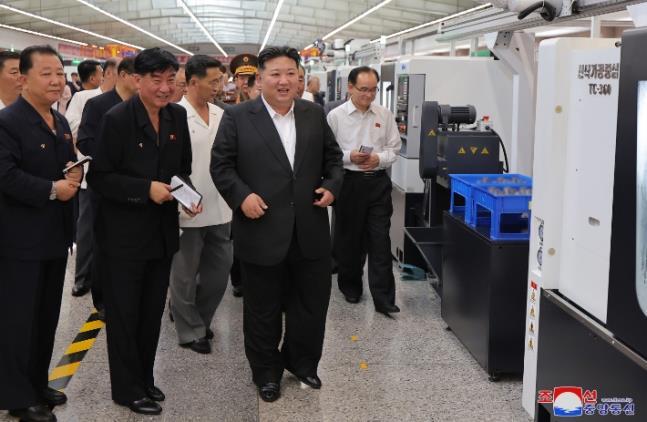
Kim Jong-un toured a defense industry factory, a key machinery factory, and a medical equipment factory
with senior central party officials on the 3rd, reported the Korean Central News Agency (KCNA). / KCNA
The meeting also addressed measures to tighten internal controls within North Korea. Kim Jong-un praised the improved role of legal institutions in ensuring party decisions and social stability and emphasized the need for enhanced legal oversight to establish discipline across all areas of social life and effectively address key issues for the people's livelihood. This indicates a continued effort to prevent ideological relaxation, particularly among North Korea's youth.
Interestingly, there were no public statements on foreign relations or a new treaty with Russia during this Plenary Meeting. It's speculated that detailed military evaluations and the North Korea-Russia treaty implementation were discussed but not disclosed. Observers suggest North Korea may be taking a strategic break before unveiling new constitutional amendments at the upcoming Supreme People's Assembly, which may include removing terms like 'unification' and 'same ethnicity.'
North Korea Falsely Claims Success Amid Consecutive Missile Failures
North Korea has been falsely presenting its recent missile test launches as successful despite a series of failures. This seems to be an effort to avoid the embarrassment that comes with repeated failures.
On the 2nd, North Korea announced it had conducted a "minimum range test launch of a tactical missile with a super-large warhead." However, South Korean military authorities cast doubt on this claim, suggesting that a likely failed ballistic missile test was being misrepresented as a success.
North Korea claimed that the Hwasongpho-11 Da-4.5 missiles, capable of carrying a 4.5-ton warhead, were tested to verify flight stability and accuracy at a maximum range of 500 kilometers and a minimum range of 90 kilometers.
The Hwasongpo-11, also known as the “North Korean Iskander” or KN-23, reportedly had its warhead weight increased from the typical 500 kg to 2.5 tons and up to 4.5 tons, intended to demonstrate its Bunker Buster-grade destructive power.
Of the two missiles launched, the first, with a range of 500 km, reached the East Sea near Chongjin. However, the second missile, aimed at an inland range of 90 km, would have landed near Pyongyang if direction and distance are estimated correctly.
Given that a large WPK Plenary Meeting attended by Kim Jong-un was occurring in Pyongyang on the 1st, it seems improbable that a missile was deliberately aimed at Pyongyang. This leads to speculation that the second missile might have gone off course. A Republic of Korea Joint Chiefs of Staff official called North Korea’s claims deceptive, doubting that a missile with a 4.5-ton warhead was test-launched inland, suggesting the claim might be fabricated.
The JCS had previously noted that the second missile possibly failed, stating, “If it was a short-range ballistic missile (SRBM), it did not reach the required altitude.” Not reaching the necessary peak altitude implies an abnormal trajectory during its ascent phase.
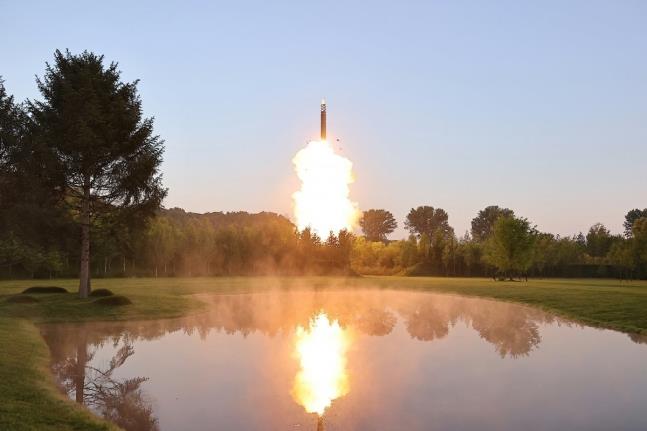
North Korea launched two new tactical ballistic missiles, the Hwasongpho-11 Da-4.5, capable of carrying a 4.5-ton warhead,
from Jangyon, Hwanghae-do, on the 1st, with footage showcased. / Rodong Sinmun
Reports indicate that the missile veered off course after launch, ultimately landing in an uninhabited area north of Pyongyang. North Korea had previously experienced failure in launching reconnaissance satellite No. 2 on May 27.
Additionally, a missile launched on June 26 exploded mid-air. Although North Korea claimed it was a “multi-warhead missile test,” South Korean military surveillance clearly showed the missile breaking into fragments. North Korea reported the test launch of the Hwasongpo-11 Da-4.5 through its external media, the Korean Central News Agency (KCNA), but did not publish it in Rodong Sinmun, the WPK’s official newspaper for domestic audiences. No related photos were released.
Considering the missile had landed inland and was likely known to the residents, North Korea seemed hesitant to publicize it as a success through its official media, indicating an effort to manage internal perceptions.
North Korea Debuts 'Kim Jong-un Badge' as Leader Solidifies Unique Status on 40th Birthday
At the recent plenary meeting, officials were seen wearing badges featuring Kim Jong-un's face, which was a first in North Korea. Analysts interpret this as an effort to bolster Kim Jong-un's unique leadership status, distinguishing him from his predecessors.
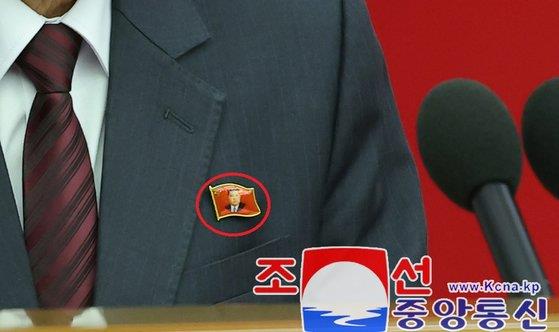
During the 10th Plenary Meeting of the 8th Central Committee, held in Pyongyang from June 28 to July 1,
officials wore badges featuring Kim Jong-un's face. / Korean Central News Agency
Photos from the second day of the plenary meeting, as reported by state media like Rodong Sinmun, showed all attending officials with badges displaying only Kim Jong-un's face. Although there have been mentions of these badges being produced since Kim Jong-un's early rule in 2012, this is the first time they have been shown in public by state media.
In North Korea, it is customary for all citizens, regardless of status, to wear badges with the supreme leader's portrait. It is anticipated that the general populace will soon be seen wearing Kim Jong-un badges as well. Since Kim Jong-il's death in 2011, North Koreans have typically worn badges featuring both Kim Il-sung and Kim Jong-il.
This year, North Korea has ramped up efforts to idolize Kim Jong-un. A loyalty pledge ceremony was held on his birthday on January 8, and in May, during the opening of the Central Cadres Training School of the Workers' Party of Korea, his portrait was displayed alongside those of Kim Il-sung and Kim Jong-il for the first time.
The Ministry of Unification has noted that the introduction of badges solely featuring Kim Jong-un's face is part of a broader trend to idolize him, aiming to affirm his distinct leadership role while reducing the emphasis on his predecessors.
The Ministry noted that since the 2021 WPK Congress, marking Kim Jong-un's decade in power, idolization efforts have surged. This year, portraits of the three leaders were publicly displayed together for the first time, and the term 'Day of the Sun' has been used less frequently to commemorate Kim Il-sung's birthday.
-
PREV [NK Focus]
-
NEXT [NK Focus]