

Kim Jong-un's Leadership at Risk if Local Industrial Policy Fails
Han Ki-beom
the deputy director of the NIS
(Visiting Researcher at The Asan Institute for Policy Studies)
In his January 15 speech to the Supreme People's Assembly, Kim Jong-un called the severe shortage of essential supplies for local residents a "serious political issue." He proposed the "20×10 regional development policy," aiming to build light industry factories in 20 cities and counties each year for the next 10 years to produce basic food, clothing, and daily necessities. In North Korea, "local industrial factories" are small- and medium-sized enterprises producing essential goods like soy sauce, soybean paste, socks, and soap. Since the regime's early days, North Korea focused on heavy industry, relying on local factories for essential consumer goods. By the early 1980s, there were about 3,300 local factories.
Many of these ceased operations during the mid-1990s economic crisis, and about 1,800 factories were closed during early 2000s restructuring. Today, around 2,900 rebuilt and modernized factories maintain the local economy, but these industries remain vulnerable due to unstable raw material procurement, power supply, and management efficiency, all relying on local self-management without central support.
Ongoing efforts since Kim Jong-un took power haven't significantly advanced local development. However, North Korean media have been promoting local industry development more frequently this year. This follows Kim Jong-un's promise to expand light industry factories after addressing the severe shortage of essential supplies at the Supreme People's Assembly meeting in January. He highlighted the unmet "simple living requirements of our people" and the severe "gap between the capital and local areas," announcing the "20×10 regional development policy."
To solidify this initiative, North Korea convened the Politburo of the Workers' Party on January 23-24 at Myohyang Mountain. Kim Jong-un emphasized that "the reality of not being able to provide even basic daily necessities to local residents is a serious political issue," calling the "20×10 regional development policy" a transformative policy for actual implementation, not mere propaganda. His remarks hinted at critical local sentiment, reminiscent of Kim Il-sung’s "National Meeting of Machine-Industry Workers" in July 1994, held just before his death to address an economic crisis.
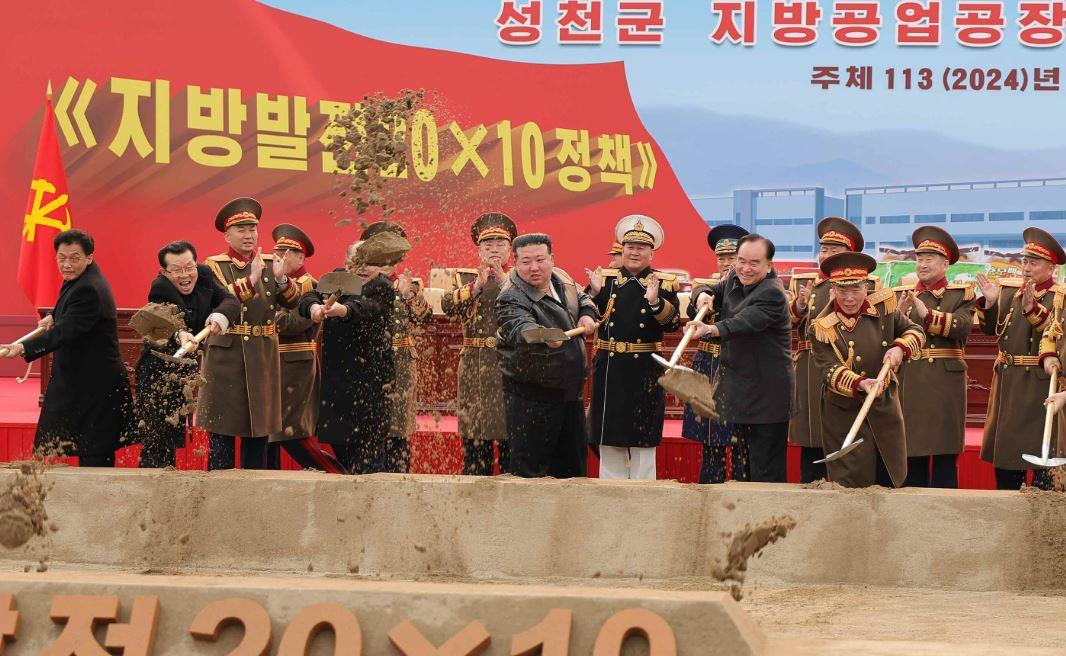
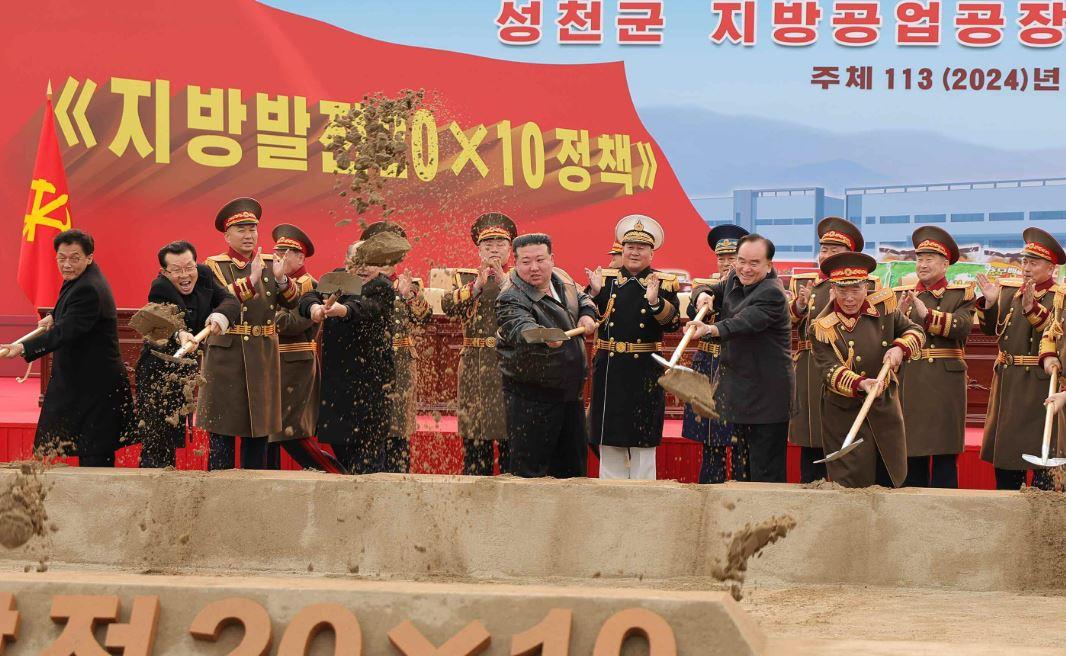
Kim Jong-un breaks ground at the ceremony for a local industrial factory
in Songchon County, South Pyongan Province, on February 28. / Rodong Sinmun
The "local industrial development" policy involves the central government providing necessary funds, materials, and equipment, the military mobilizing construction personnel, and local areas managing operations. At the Songchon County factory groundbreaking ceremony on February 28, Kim Jong-un declared, "The state will fully guarantee the funds, efforts, cement, and steel needed for factory construction." The military, tasked with construction, formed the "Emergency Defense Ministry Command for 20×10 Regional Development" under the Ministry of Defense, creating regional organizations such as the 124th Regiment, mobilizing an estimated 40,000 military construction workers.
Kim Jong-un is pushing the local industrial development policy and rushing factory construction with full party, government, and military support mainly due to the unusual discontent among local residents who feel relatively deprived compared to those in Pyongyang.
According to defectors, since Kim Jong-un took power, the gap between Pyongyang and the provinces has worsened due to elite corruption and wealth accumulation. Public services like food distribution, medical care, heating, and water supply have also declined. Since 2017, economic sanctions, border closures, and COVID-19 have further shrunk the economy, worsening living conditions for local residents.
When COVID-19 controls were lifted in fall 2022, local residents, nearly starving, began to express their dissatisfaction. Food distribution outside Pyongyang worsened, causing even Kaesong residents to starve. This deprivation is hinted at by Kim Jong-un’s remarks during the February 28 groundbreaking ceremony for the "Emergency Defense Ministry Command for 20×10 Regional Development," where he said, "I feel ashamed and sorry for starting only now," and the residents' reactions, "We are so grateful to him for doing it.“ (Rodong Sinmun, February 11).
Kim Jong-un's rush in local industrial development seems to show goodwill ahead of the 80th Party Foundation Day in October 2025 and the 9th Congress of the Workers' Party in January 2026. With next year marking the "8th Congress business review," North Korean authorities need achievements to improve people's lives. The "20×10 regional development policy," spanning 10 years, also appears to be a strategy to buy time.
Promoting local economic development aims to boost the domestic market amid ongoing sanctions. Despite increased foreign trade, 90% of exports remain restricted, limiting foreign currency earnings. Investing in local industries to supply essential goods and generate revenue is seen as a way to meet domestic demand. In conclusion, the "20×10 regional development policy" is expected to achieve limited, temporary success given Kim Jong-un's determination and propaganda trends. Newly established factories will provide certain benefits to local residents for 2-3 years. However, without confirmed priority adjustments for urgent economic projects, securing continuous investment funds remains challenging. The policy, aimed at buying 10 years of time to mitigate public dissatisfaction, is unlikely to fundamentally resolve local residents' living difficulties.
Kim Jong-un's sudden directive, without considering business conditions and prospects, may negatively impact other economic policies. He previously criticized the "five-year economic development strategy (2016-2020)" for failing due to "unrealistic subjective desires" of officials. If the "20×10 regional development policy" fails for similar reasons, his leadership could suffer, and local resentment could grow. Kim Jong-un's economic projects, such as the Masikryong Ski Resort, Wonsan-Kalma Coastal Tourist Area, over 20 economic special zones, and the Pyongyang General Hospital, were poorly executed but largely escaped blame. However, this new policy directly affects the daily lives of local residents, and its failure could have significant internal repercussions.
Recently, Kim Jong-un has introduced several major policy initiatives. Following the internal "erasing of the nation" after defining inter-Korean relations as hostile, he has reinforced his solitary stance by "erasing the predecessors" since the Sun's Day in April. Emphasizing the "benevolent father" image by promoting local industrial development amid a severe "shortage economy" suggests spreading negative perceptions of Kim Jong-un's leadership due to the prolonged nuclear missile advancement policy.
If the nationwide effort to promote local development fails amid the confusion, public sentiment in North Korea will worsen, damaging Kim Jong-un's leadership. Although unlikely, success with the "20×10 regional development policy" could reduce his belligerence and lead to positive changes by expanding economic interests.
-
PREV [News & Issues]
-
NEXT [NK Focus]