

Russia's Determination: Why We Should Be Worried

Lee Ju-yeon
Research Fellow at the Asia-Pacific Research Center, Hanyang University
Russia's Alliance Strategy in Different Domestic and International Situations
On June 19, 2024, President Vladimir Putin visited North Korea for a summit with leader Kim Jong-un, his second visit since July 2000. Comparing the two visits, the differences and implications are clear, especially that this visit is driven more by international factors than domestic ones. In 2000, when Putin was first elected, his approval rating was a steady 70%, but he hadn't yet fully controlled domestic politics. By contrast, in 2024, he was re-elected with 87% of the vote, securing overwhelming support for his fifth term and complete control over domestic politics through his inner circle, including the Siloviki.
Unlike the stable domestic situation, Russia's international circumstances have changed dramatically. In the 1990s, Russia experienced significant political and economic turmoil, reducing its global influence. However, in the 2000s, rising international oil prices and a shift to state capitalism through the renationalization of key industries enhanced Russia's global presence, leading to a more aggressive foreign policy. On February 24, 2022, Russia invaded Ukraine in what it called a "special military operation," and the Russia-Ukraine war continues. Therefore, Putin's recent visit to North Korea appears driven more by international factors like the Ukraine war rather than domestic stability.
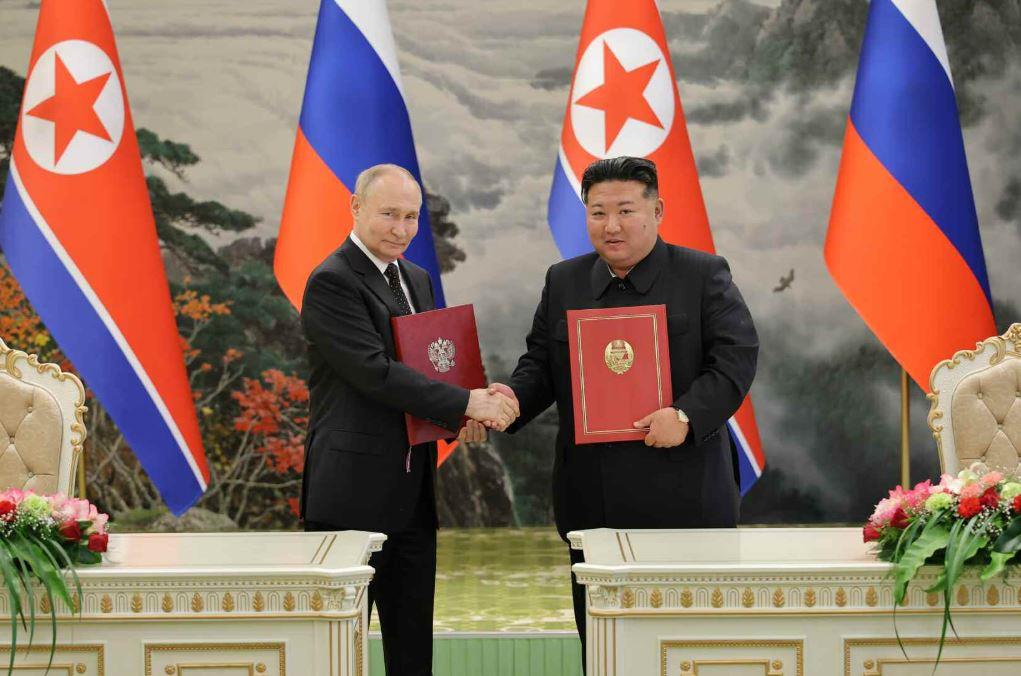
Russian President Vladimir Putin (left) and Kim Jong-un hold a press conference after their meeting
in Pyongyang, North Korea, on the 19th. /Rodongshinmun
Putin's visit to North Korea can be linked to several factors related to the Ukraine war. First, the war is stabilizing. After Russia repelled Ukraine's counteroffensive in 2023, the front lines reached a stalemate, giving Russia a more aggressive stance. Second, the Ukraine war has divided the international community, reminiscent of Cold War-era bloc conflicts. For example, the South Korea-U.S.-Japan summit took place at Camp David on August 18, 2023, and Kim Jong-un visited Vladivostok for a North Korea-Russia summit on September 13, 2023. Third, the visit serves as a warning to unfriendly countries and signals a red line to South Korea. In summary, as the Ukraine war stabilizes, Russia is bolstering its ties with traditional allies like North Korea, leading to this summit.
Strengthening Russia-North Korea Military Relations and the Korean Peninsula Crisis
The summit led to Russia and North Korea announcing a "comprehensive strategic partnership," highlighting much closer ties between the two nations. Articles 3 and 4 of the treaty, made public by North Korea, could be problematic for South Korea as they permit mutual military intervention during emergencies. Despite ongoing debates, it appears that a security relationship akin to a military alliance has been established. For Russia, gaining a reliable ally in Northeast Asia marks this visit to North Korea as highly successful.
The issue is that these close military ties between Russia and North Korea pose a serious security threat to South Korea. While some might view Putin's subsequent visit to Vietnam as part of Russia's broader strategy for a multipolar international community, from an optimistic standpoint, the strengthening of traditional alliances could be seen as both a cause and a result of Putin's visit to North Korea.
Russia's stance on the Korean Peninsula has traditionally been more favorable to South Korea, valuing economic benefits over the geopolitical stability and military cooperation offered by North Korea. While Russia hasn't actively pushed for Korean unification, it has shown interest in denuclearization and peace on the peninsula. However, the recent Russia-North Korea summit indicates a shift in Russia's focus from economic benefits to security interests.
So, the current situation shouldn't be viewed with simple optimism because Russia and North Korea share similar tendencies. While their influence in the international community and their economic and military scales may differ, they both have significant conflicts with the U.S. and the West. If their domestic stability is threatened, they are likely to use force actively. This means that beyond just forming alliances, practical military actions are possible. There is also the possibility that Russia might transfer nuclear missile technology to North Korea or tolerate North Korea's possession of nuclear weapons, even without direct military moves like in the Ukraine war.
The chances of Russia and North Korea triggering worst-case scenarios, like starting a war on the Korean Peninsula or transferring nuclear technology, are still low. However, we can't ignore Russia's decisiveness, as shown in the Ukraine war. We need to be cautious not only about Russia's energy resources, nuclear weapons, military power, and close ties with North Korea but also about their underlying resolve.
Closer military ties between Russia and North Korea undoubtedly threaten South Korea's security, necessitating an active response. South Korea should address security crises through its alliance with the U.S. and strengthen cooperation with friendly countries. However, we must not overlook Russia's decisiveness. Rather than severing diplomatic relations, South Korea should maintain these ties and work to resolve the crisis on the Korean Peninsula through diplomatic means.
-
PREV [Column]
-
NEXT [Current Affairs Analysis]