

North Korea's Complicity in Russian War Should Be
Actively Considered for Referral to the ICC
Kim Tae-hoon, Lawyer
Chairman of North Korean Human Rights,
Honorary President of Lawyers for Human Rights and Unification of Korea
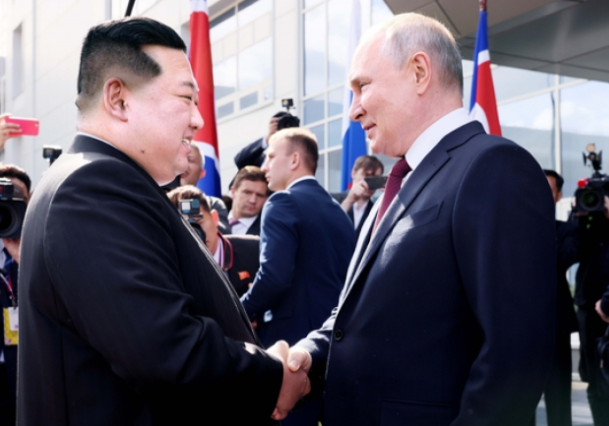
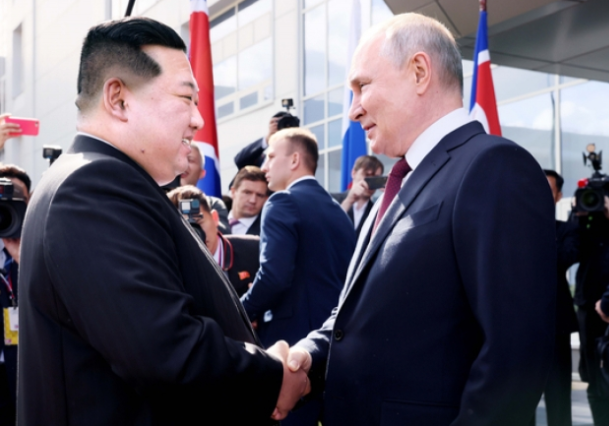
As Russian President Vladimir Putin’s visit to North Korea seems imminent, a senior official from the presidential office recently stated that “President Putin’s visit to North Korea is just days away,” making it almost certain. Structures for welcoming Putin have been spotted in satellite images at Kim Il Sung Square in Pyongyang.
AP=Yonhap News
If this visit occurs, it will be the first in 24 years since July 2000 and a return visit nine months after North Korean leader Kim Jong-un’s visit to Russia’s Far East in September last year. Putin's visit will highlight the strengthened ties between North Korea and Russia amid the new Cold War atmosphere. In his congratulatory message for Russia’s National Day on the 12th, Kim Jong-un stated, “The century-old strategic relationship will evolve to a higher level of national relations.” This aims to elevate cooperation based on the agreements from the North Korea-Russia summit last September.
Since the invasion of Ukraine began on February 24, 2022, Russia, struggling with a shell shortage, has intensified its offensive with North Korea’s extensive ammunition support, causing significant difficulties for Ukraine. After the Kim-Putin talks in September last year, thousands of containers were traded between North Korea and Russia in a “dangerous deal.” North Korea supplied Russia with conventional weapons like shells and rockets in exchange for food, refined oil, weapon parts, and technology. Additionally, Russia has neutralized the UN’s monitoring of sanctions against North Korea.
As a result, the damage to Ukrainian civilians and civilian facilities has been severe. According to the Office of the United Nations High Commissioner for Human Rights (OHCHR), in May alone, Russian forces expanded missile and bomb attacks on densely populated areas in Kharkiv in northeastern Ukraine, resulting in 174 civilian casualties, the highest since June 2023. According to the Royal United Services Institute (RUSI), which has tracked North Korea’s arms shipments to Russia, around 7,000 North Korean containers had been imported to Russia by January, carrying millions of rounds of ammunition and rockets capable of large-scale bombardment.
Ukraine, providing evidence that North Korean weapons were used, released photos of missile fragments, criticizing Russia for attacking seven regions of Ukraine with North Korean missiles 12 times between late December and early February. They claimed that Russia launched 50 North Korean missiles into Ukrainian territory, killing at least 24 people and injuring over 70.
Despite this, North Korea’s weapon supply to Russia continues. In April, the Russian cargo ship Lady R, sanctioned by the U.S. for transporting weapons used in the Ukraine war, reportedly docked at Vostochny Port in Russia’s Far East and Rajin Port in North Korea, according to satellite images analyzed by The Yomiuri Shimbun on the 9th. The Yomiuri Shimbun suggests this was part of an illegal arms trade between North Korea and Russia, with North Korea supplying weapons and ammunition for Ukraine attacks in exchange for refined petroleum products from Russia.
The international community is concerned about the possibility of expanded and intensified arms transactions between Russia and North Korea during Putin’s visit. There is a possibility of North Korea increasing its supply of conventional weapons, such as shells, ammunition, and ballistic missiles, to Russia in exchange for nuclear submarine, ICBM technology, reconnaissance satellites, and fighter jets, or even agreeing on joint weapon system development and military cooperation. On the 9th, U.S. President Joe Biden and French President Emmanuel Macron, during Biden's first state visit to France since taking office, condemned Russia’s invasion of Ukraine and strongly criticized North Korea’s provision of ballistic missiles and ammunition to Russia.
The Ukraine war marks a significant crisis, with a Permanent Member of the UN Security Council invading another sovereign nation, violating Article 2, Paragraph 4 of the UN Charter. It raises serious questions about the existence and usefulness of the UN system and the Security Council. Russia continues to receive weapons and supplies from North Korea in direct violation of UN sanctions. On March 28, due to Russia's veto, the expert panel under the UN Sanctions Committee on North Korea, which had been extending its activities annually since 2009 to monitor violations, ceased its activities on April 30.
This blatant act of condoning and encouraging North Korea’s illegal actions is due to Russia’s need for weapons for the Ukraine war. If North Korea receives information and technology to enhance its Weapons of Mass Destruction (WMD) capabilities in exchange for supplying conventional weapons to Russia, the North Korea-Russia military transactions pose a significant military threat not only to Ukraine but also to South Korea's security and peace, as well as global peace and stability.
The international community has long tried to hold North Korea accountable for its human rights violations by referring the North Korean situation to the International Criminal Court (ICC). On the 12th, during the UN Security Council meeting on North Korean human rights, OHCHR’s High Commissioner Volker Turk emphasized the need for accountability for long-standing severe and widespread human rights violations, supporting the UN Commission of Inquiry (COI) recommendation from ten years ago to refer the North Korean situation to the ICC.
However, such a referral has been blocked by China and Russia, both Permanent Members of the Security Council. Nevertheless, Russia’s war crimes in Ukraine and North Korea’s complicity in these crimes fall under the jurisdiction of the ICC without needing a UNSC referral.
Russia’s invasion of Ukraine, marked by intentional and indiscriminate attacks on civilians and infrastructure, is a serious breach of the Geneva Conventions of August 12, 1949. These actions likely constitute war crimes under Article 8, Paragraph 2 (a) of the Rome Statute of the ICC, including willful killing (Clause 1), inflicting great suffering or serious injury (Clause 3), and extensive destruction and appropriation of property not justified by military necessity (Clause 4). North Korea’s provision of shells and missiles to Russia supports these war crimes, potentially violating Article 25, Paragraph 3 (c) of the ICC Statute by aiding the commission or attempted commission of war crimes.
For the ICC to address war crimes or aiding and abetting such crimes, it must have jurisdiction. This can be established in three ways: first, a State Party to the Rome Statute may refer a situation where crimes under the Court's jurisdiction appear to have been committed (Article 13 (a)); second, the UNSC can refer a situation under Chapter VII of the UN Charter (Article 13 (b)); third, the ICC Prosecutor can initiate an investigation proprio motu (Article 13 (c)). Except for UNSC referrals, the following conditions must be met under Article 12, Paragraph 2 of the Rome Statute: the State where the crime occurred is a Party to the Statute or has accepted the Court’s jurisdiction, or the accused is a national of a State Party or one that has accepted the Court’s jurisdiction.
On March 5, the ICC issued arrest warrants for Russian Air Force Lieutenant General Sergey Kobylash and Navy Admiral Viktor Sokolov, based on reasonable grounds to believe they committed war crimes by attacking civilian infrastructure in Ukraine with missiles from October 10, 2022, to March 9, 2023. Earlier, on March 17, 2023, the ICC issued arrest warrants for President Vladimir Putin and another individual for war crimes, including forcibly deporting children. The ICC could issue these warrants because, although neither Russia nor Ukraine is a State Party to the Rome Statute (Russia withdrew in 2016), Ukraine accepted the ICC’s jurisdiction over crimes committed on its territory since February 2014. Therefore, the ICC also has jurisdiction over North Korea as a co-perpetrator of Russia’s war crimes on Ukrainian territory.
On the 24th of last month, the South Korean and Japanese governments independently announced sanctions against individuals and entities involved in North Korea-Russia arms transactions.
The South Korean Ministry of Foreign Affairs stated "Our government's actions were taken in close collaboration with our allies and are anticipated to strengthen the international sanctions network." In a similar move, Japan's Ministry of Foreign Affairs imposed sanctions on nine Russian companies, one individual, and two companies operating outside Russia and Belarus. Looking ahead, South Korea and Japan should enhance their cooperation beyond sanctions, aiming to judicially condemn North Korea’s arms supply to Russia and to halt North Korea-Russia military cooperation based on international criminal law.
Both South Korea and Japan are ICC State Parties and active members of the UN Security Council. The trilateral cooperation between South Korea, the U.S., and Japan, solidified during the Camp David summit in August, aims to improve North Korean human rights and foster global peace. To combat human rights violations from North Korea’s military support to Russia, South Korea should monitor civilian casualties in Ukraine, publicize North Korea’s arms activities, mobilize international pressure, and seriously consider referring North Korea and Russia’s war crimes complicity to the ICC.
-
PREV [NK Focus]
-
NEXT [News & Issues]