

Kim Myongsung’s Inside North Korea
· Increased Provocations after Satellite Failure: Kim Jong-un Directs Artillery Drills Targeting South Korea Three Days Later
· North Korea Released Over 1,000 Garbage-Filled Balloons and Continued GPS Jamming, Causing 1,400 Cases of Interference
· North Korea Lays Mines along 284km of the Armistice Line... First Comprehensive Mine Deployment since the 1953 Armistice Agreement

Kim Myungsung
On the night of the 27th last month, North Korea launched the reconnaissance satellite 'Malligyong-1-1', but the rocket's first stage exploded two minutes after launch. Since then, North Korea has escalated provocations against the South, including garbage-throwing, GPS jamming, and launching over 10 Super-large Multiple Launch Rocket Systems, believed by analysts to divert attention from the satellite launch failure.
The Korean Central News Agency (KCNA) reported on May 28th that North Korea's National Aerospace Technology Administration launched the reconnaissance satellite 'Malligyong-1-1' with a new carrier rocket from the West Sea Satellite Launch Site on the 27th. However, the rocket's first stage exploded mid-flight, leading to a failed launch.
The recent launch was the first in about six months since November 21 of last year. North Korea had attempted to launch reconnaissance satellites on May 31 and August 24 of the same year but failed to place them into orbit. According to our military analysis, even the first reconnaissance satellite, which North Korea claims was successful, was not functioning properly in its reconnaissance role.
The satellite launch coincided with the Korea-China-Japan summit in South Korea, where a joint declaration on 'denuclearization of the Korean Peninsula' was announced. Analysts believe North Korea, favoring a North Korea-China-Russia bloc against South Korea-US-Japan, launched the satellite as retaliation against the closer South Korea-China relationship but failed due to technical issues.
On the 28th of last month, a day after the satellite launch failure, Kim Jong-un visited the State Academy of Defense Sciences and declared that North Korea would take 'absolute and overwhelming decisive actions' against the South.
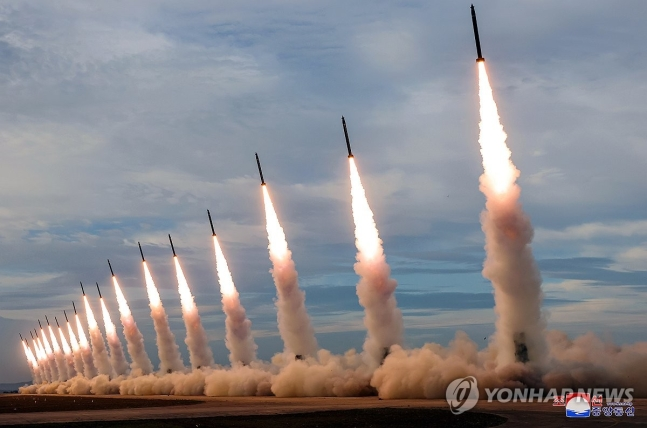
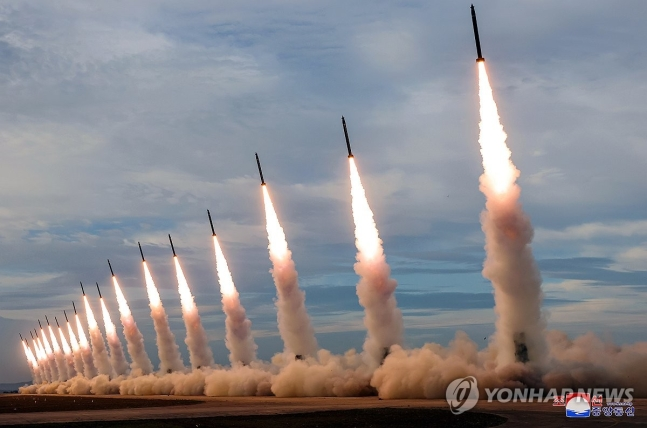
A scene of North Korea simultaneously launching 18 Super-large MLRS with a range of 400km
from the Pyongyang Sunan area on the morning of May 30th / Korean Central News Agency Yonhap News
On the 30th, North Korea announced that under Kim Jong-un's guidance, they conducted a power demonstration using Super-large Multiple Launch Rocket Systems targeting the South. The launcher, codenamed KN-25 by South Korean and US intelligence, is an SRBM with a range of 400km, capable of carrying tactical nuclear warheads.
On the 31st of last month, the KCNA reported that “when the enemies attempt to use military force against the Republic, the demonstration firing of the super-large rocket launcher units was conducted to clearly show our will to preemptively exercise our right to self-defense, including preemptive strikes if necessary.” The agency reported that Kim personally ordered the organization of the demonstration firing.
The Republic of Korea Joint Chiefs of Staff announced that they detected more than 10 short-range ballistic missiles (SRBMs) presumed to be launched from the Pyongyang Sunan area towards the East Sea around 6:14 a.m. the previous day. North Korea clarified that the multiple rocket launcher firing was a 'demonstration firing' to show their response to the South, emphasizing its nature as a show of force.
KCNA reported that Kim Jong-un declared, "Today's power demonstration firing will unmistakably show our adversaries the severe consequences they will face if they dare provoke us," adding, "Our nuclear forces must be thoroughly prepared to swiftly and accurately execute their critical mission of war deterrence and achieving war dominance under any unforeseen circumstances."
The firing was executed using the 'Integrated Fire Command System,' part of the national nuclear weapons management system.
After the Central Military Commission of WPK sent the 'secret code command,' Kim Jong-un issued the order from the observation post. Artillerymen claimed they "successfully hit the island target 365km away and excellently performed the power demonstration mission." Photos released by North Korea showed 18 Transporter Erector Launchers (TELs) lined up, each launching a super-large rocket simultaneously.
North Korea Released Over 1,000 Garbage-Filled Balloons and Continued GPS Jamming, Causing 1,400 Cases of Interference
Since last month, North Korea has launched over 1,000 garbage-filled balloons into South Korean territory on two occasions and continued GPS signal jamming attacks. Analysts interpret these actions as efforts to destabilize South Korean society and incite anxiety while avoiding direct military retaliation through low-intensity provocations.
The Republic of Korea Joint Chiefs of Staff reported that about 260 garbage-filled balloons from North Korea were detected in various regions on the 28th and 29th of last month. Around 720 more were found on the 1st and 2nd of this month. Including unconfirmed sightings, it's estimated that over 1,000 balloons were launched, a third of North Korea's total.
On June 2nd, KCNA reported that Kim Kang-il, North Korea's vice minister of defense, announced a temporary halt to the garbage balloon releases. He stated, "From the night of May 28th to early June 2nd, we released 15 tons of waste paper using over 3,500 devices near the South Korean border and in the metropolitan area."

On June 2nd, a suspected North Korean balloon damaged a car's windshield in a villa parking lot
in Danwon-gu, Ansan, Gyeonggi Province. / Gyeonggi Nambu Provincial Police
The indiscriminate release of garbage balloons from North Korea has caused various damages. Balloons found in and around Incheon International Airport disrupted aircraft takeoffs and landings for about 91 minutes.
According to police reports, at 10:22 a.m. on June 2nd, a 5kg plastic bag with a garbage balloon attached fell on a Grandeur car in a villa parking lot in Gojan-dong, Danwon-gu, Ansan, shattering the windshield. Earlier, at 5:40 a.m., a balloon fell on a parked Sorento in Sinjeong-2dong, Yangcheon-gu, Seoul, breaking the passenger seat window. By June 2nd, police received 860 reports related to the garbage balloons.
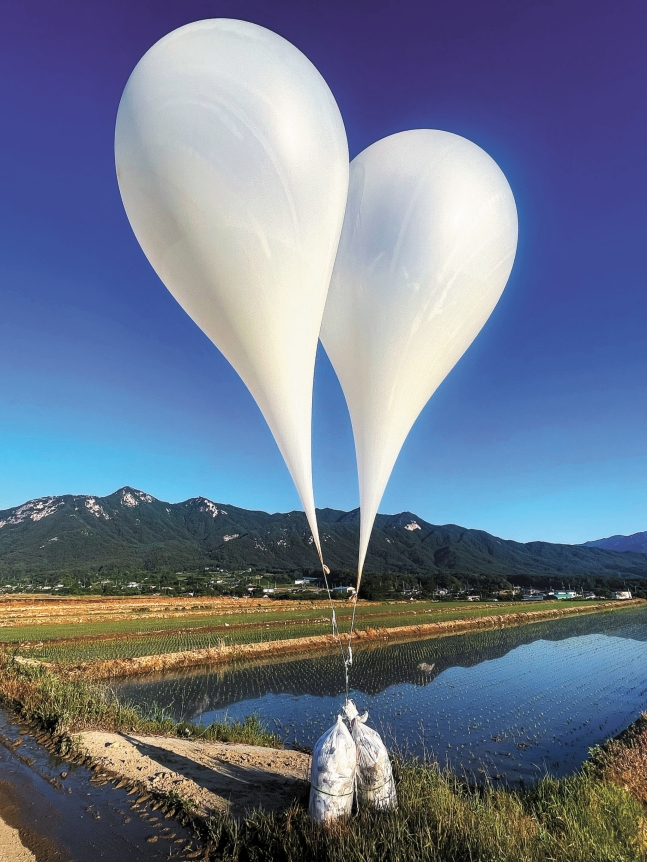
A garbage-filled balloon from North Korea found in a rice field
in Wicheon-myeon, Geochang County, on May 29th. / KyungnamShinmun
Meanwhile, North Korea's GPS signal jamming attack, which began on May 29th, caused significant issues for South Korean naval vessels, which experienced GPS signal reception problems 101 times. According to the government's 'Daily Management Situation for National Safety,' a total of 1,409 reports of GPS signal reception issues, including those from naval vessels, were received between May 29th and June 2nd. These GPS jamming attacks by North Korea also significantly impacted fishermen.
In response, the South Korean government held an emergency National Security Council (NSC) meeting on June 2nd and announced, "We have decided to implement measures that North Korea will find difficult to endure." These measures reportedly include resuming psychological warfare tactics, such as loudspeaker broadcasts aimed at North Korea.
Analysts suggest that North Korea's swift decision to temporarily suspend the release of garbage balloons was influenced by the South Korean government's move to resume loudspeaker broadcasts targeting North Korea.
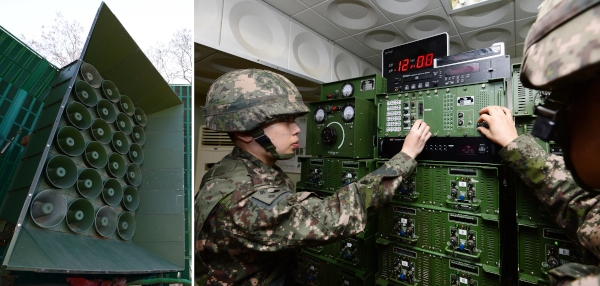
In January 2016, right after North Korea's fourth nuclear test, soldiers from a front-line unit in Gyeonggi Province broadcasted messages aimed
at North Korea (right). The left photo shows the loudspeakers used./Kukmin Ilbo
North Korea Lays Mines along 284km of the Armistice Line... First Comprehensive Mine Deployment since the 1953 Armistice Agreement
North Korea is currently laying mines along the northern areas of the 248km-long Military Demarcation Line (MDL) from east to west. This marks the first comprehensive mine deployment in the Armistice Line area since the signing of the Armistice Agreement in 1953. Analysts believe this move aims to create a permanent physical division of the Korean Peninsula.
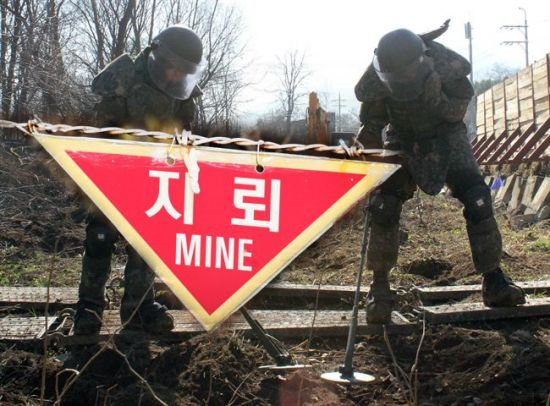
South Korean soldiers detecting mines in the Demilitarized Zone (DMZ) in 2018./ Ministry of National Defense
According to a South Korean government source in mid-May, North Korea has been deploying hundreds to thousands of troops daily since April to lay mines along the Armistice Line. The mined areas extend from the eastern coastal axis near Goseong, Gangwon Province, to the northern sections of the central front near Cheorwon and Yeoncheon in Gyeonggi Province. Recently, operations have expanded to the southern areas of Kaesong on the western front, covering the entire front line established during the Korean War.
Previously, in early December, North Korea began laying mines in the DMZ, including the Gyeongui Line land route. In a January speech to the Supreme People's Assembly, Kim Jong-un stated that "step-by-step measures must be taken to thoroughly separate north-south connections in the border areas." The current comprehensive mine-laying efforts are seen as part of a larger strategy to turn the inter-Korean demarcation line into a de facto national border following Kim's directive.
In December last year, North Korea laid mines on the Gyeongui Line (western) and Donghae Line (eastern) routes within the DMZ, the only land connections between North and South Korea, leading to the Kaesong Industrial Complex and Mount Kumgang. Mines were also laid in the northern section of the DMZ's Arrowhead Hill tactical road, opened for joint remains excavation as part of the 9.19 Inter-Korea Military Agreement. By targeting roads symbolizing inter-Korean exchange and reconciliation, North Korea emphasized its intent to sever relations. Now, the regime is extending these efforts by deploying large-scale troops to densely mine previously unmined sections.
Starting this month, North Korea has significantly expanded mine-laying areas by deploying heavy equipment, such as excavators, within the DMZ. While small excavators were used in October 2018 for the Arrowhead Hill tactical road, this is the first time since the armistice that large excavators have been brought in for hostile purposes.
North Korea's extensive mine-laying across the entire front, covering the western, central, and eastern areas, is seen as an attempt to revert inter-Korean relations to the hostile confrontation period immediately after the Korean War or the Armistice Agreement. In his January speech, Kim Jong-un declared that "the very concepts of unification, reconciliation, and same ethnicity must be completely eliminated" and instructed that South Korea be designated as the 'primary enemy' in North Korea's constitution.