

Assessment of the 9th China-Japan-South Korea Trilateral Summit
and South Korea's Position

Lee Ki-tae
Director, Global Strategy Research Division at the Korea Institute for National Unification
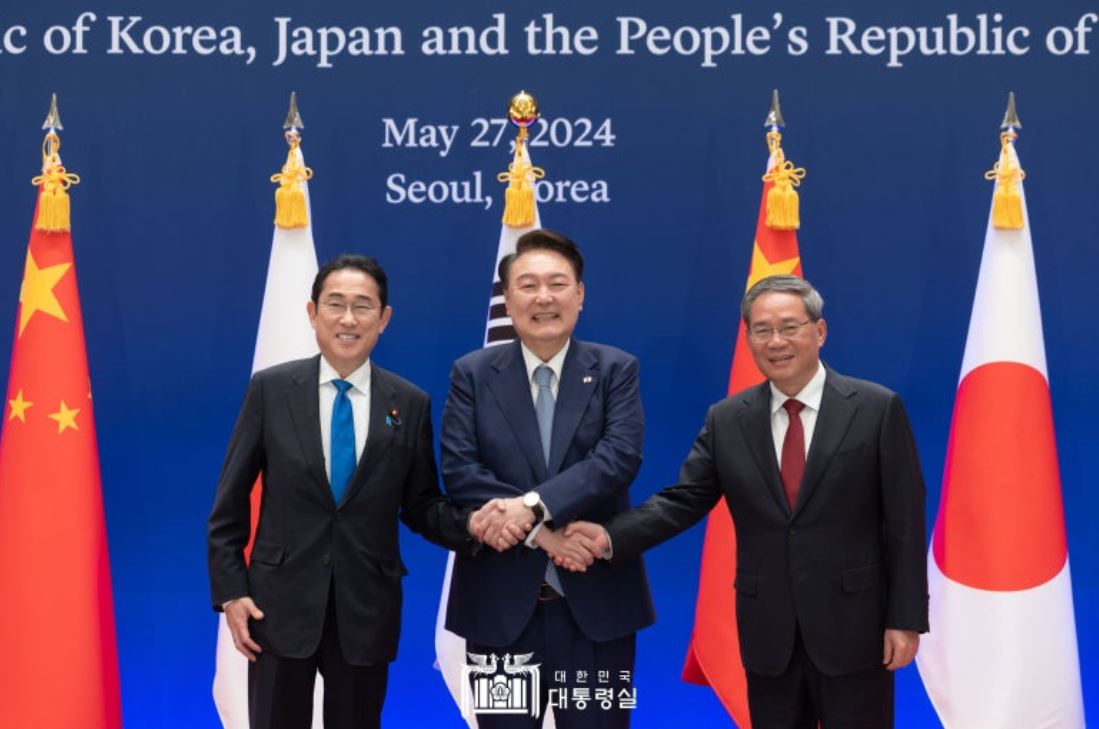
On May 27, 2024, the 9th China-Japan-South Korea Trilateral Summit took place in Seoul, attended by South Korean President Yoon Suk-yeol, Japanese Prime Minister Kishida Fumio, and Chinese Premier Li Qiang. The summit, delayed since 2019 due to COVID-19 and Korea-Japan conflicts, marked its return after 4 years and 5 months. A significant outcome was the commitment by the three leaders to regularize future summits.
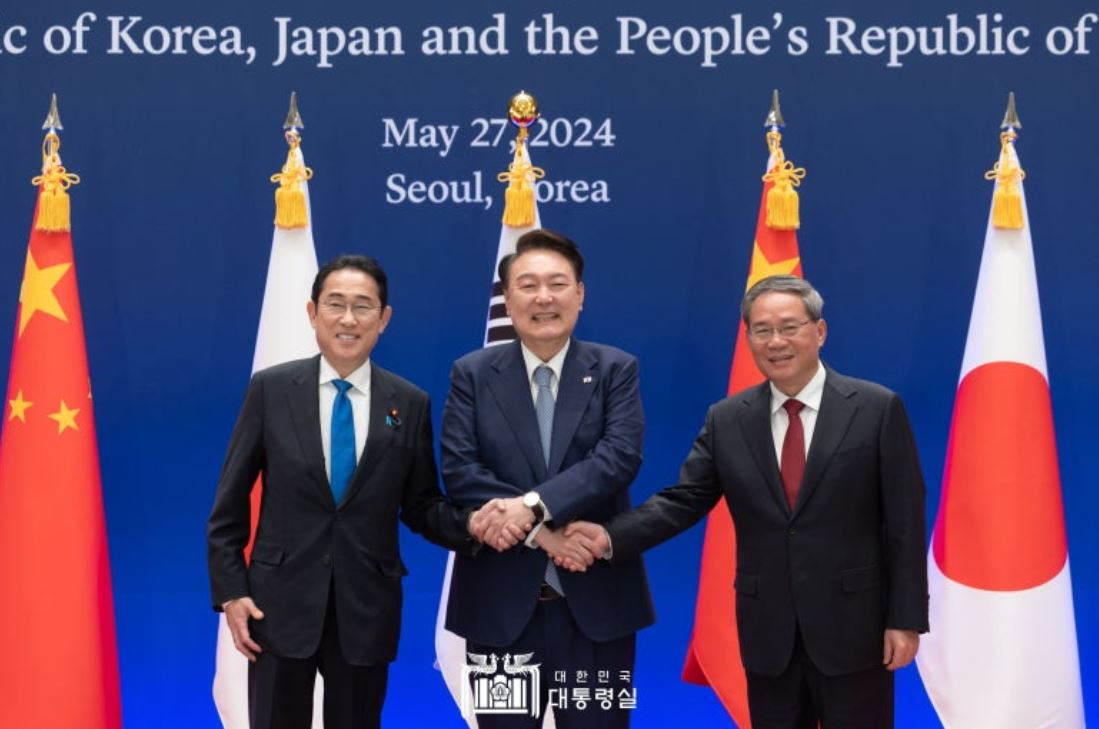
President Yoon Suk-yeol, Japanese Prime Minister Kishida Fumio, and Chinese Premier Li Qiang shaking hands
at the 9th Trilateral Summit held in Seoul on May 27 / Office of the President Republic of Korea
Since Yoon administration began in 2022, there have been significant improvements in Korea-Japan relations and progress in Korea-U.S.-Japan security cooperation. The discussions on trilateral cooperation among South Korea, Japan, and China are crucial, as they helped address the criticisms that the Yoon administration was overly focused on the Korea-U.S.-Japan framework. This summit has helped to some extent in alleviating these criticisms.
The 9th summit resulted in several key achievements. The leaders adopted a joint declaration focusing on six major areas: human exchanges, sustainable development through climate change response, economic and trade, health and aging, scientific and technological digital transformation, and disaster relief and safety. They set a goal to increase the number of travelers among the three countries from 30.54 million in 2018 to 40 million by 2030, emphasizing the importance of strengthening ties through exchanges between future generations.
The joint declaration also included a commitment to "continue discussions to accelerate negotiations" for a Free Trade Agreement (FTA) among the three countries. This agreement is seen as a response to China's request amid its worsening economic situation, with both South Korea and Japan believing that promoting fair free trade in China would be beneficial.
The summit's high-level agreement on economic cooperation in six key areas and the active communication among the leaders are praiseworthy. However, significant divisions between South Korea, Japan, and China on security issues, including economic security, were also evident.
In the joint declaration issued after the summit, the three countries reaffirmed their commitment to "upholding the international order based on the rule of law and international law." They also emphasized that "maintaining peace, stability, and prosperity on the Korean Peninsula and in Northeast Asia is a common interest and shared responsibility," particularly in light of North Korea's nuclear and missile developments.
However, unlike the 2018 joint declaration, which committed to the complete denuclearization of the Korean Peninsula and expressed hope for the early resolution of the abduction issue, the current declaration only reiterated the countries' respective positions on "regional peace and stability, denuclearization of the Korean Peninsula, and the abduction issue." This highlighted the differing stances of South Korea, Japan, and China on North Korea-related security issues, showing that trilateral cooperation on these matters is challenging.
The differences in stance on the North Korean issue among the three countries were also evident in their reactions to North Korea's announcement of a reconnaissance satellite launch just before the summit. President Yoon called for a firm international response, while Prime Minister Kishida Fumio stated that such a launch would violate United Nations Security Council resolutions if it proceeded. In contrast, Premier Li Qiang did not mention the launch and instead repeatedly emphasized opposition to "the world being divided into camps and blocs," seemingly referring to efforts to contain China.
Although not included in the joint declaration, China sought to enhance cooperation in the industrial chain in addition to the supply chain. Japan rejected this, viewing it as China's attempt to dominate global markets in key industries like EVs and AI. China's concept of the "industrial chain" implies involvement in the entire manufacturing process, from raw materials and components to finished products.
China's participation in the trilateral summit aims to revitalize its economy by expanding economic exchanges with South Korea and Japan amid a slowing economic growth trend. This is also a response to the Korea-U.S.-Japan cooperation amid U.S.-China strategic competition. Given the current U.S.-China confrontation, China needs to strengthen its single-party rule system, which requires continued economic development. The agreement to resume negotiations for the Korea-Japan-China FTA aims to expand trade, including South Korea and Japan, and to build an economic sphere excluding the U.S. in the Asia-Pacific region.
Another intent is to disrupt the Korea-U.S.-Japan cooperation system, which is strengthening security cooperation amid the U.S.-China confrontation. During the joint press conference, Premier Li Qiang proposed strengthening strategic communication and deepening political mutual trust, emphasizing the need for consideration of each other's core interests and major concerns and adherence to genuine multilateralism, warning against U.S. involvement in Taiwan.
The "Korea-Japan vs. China" structure is expected to become more pronounced, particularly in economic and North Korea-related security issues. Historically, the trilateral summit often stalled due to conflicts between Korea-Japan and China-Japan, forming a "Korea-China vs. Japan" dynamic. However, future confrontations are likely to see South Korea and Japan, which share values of liberal democracy, human rights, and the rule of law, united against China over political and security issues like North Korea and Taiwan. Considering this, South Korea should adopt the following foreign policy stance in the trilateral relationship:
First, South Korea should solidify the Korea-U.S. alliance-centered Korea-U.S.-Japan security cooperation system, keeping in mind that stability and peace on the Korean Peninsula lead to stability and peace in East Asia. However, it should actively avoid the perception that Korea-U.S.-Japan security cooperation aims to contain China, limiting the target of cooperation to North Korea. Future detailed discussions on how Korea and Japan will proceed with security cooperation within the Korea-U.S.-Japan framework are necessary.
Second, South Korea should pursue "conflict management" diplomacy to reduce potential conflicts among South Korea, Japan, and China. Despite the progress in Korea-Japan cooperation, potential conflicts remain over historical issues and Dokdo. South Korea needs to seek long-term solutions to these issues while managing them in the short term to prevent them from escalating into conflicts. Similarly, with China, it is important to enhance economic cooperation while reducing security-related conflicts through active dialogue and mutual exchanges.
-
PREV [Issue Focus]
-
NEXT [News & Issues]