

Diverging Interests of North Korea, China, and Russia: Analyzing the
China-Russia Summit and Its Implications for North Korean Policy
· Is North Korea Viewing China and Russia's 'Opening of the Lower Tuman River' Demand as 'Pressure'?
· China and Russia Urge North Korea, Amid Its Hostile Policies Toward South Korea, to Resume International Negotiations
· China Distances Itself from Military Cooperation or Alliance with North Korea and Russia

Dongchan Kim Assistant
President Vladimir Putin chose China for his first international visit after securing his fifth term in office. During the China-Russia summit held in Beijing on May 16, 2024, President Xi Jinping and President Vladimir Putin reaffirmed that their countries share a "comprehensive strategic cooperative partnership." Despite historical tensions such as the Sino-Soviet split during the Cold War and lingering issues after the Soviet Union's dissolution, China and Russia have overcome these challenges. The main factor driving this partnership is their shared strategic stance towards the United States.
As the strategic competition between the U.S. and China intensifies, China finds it crucial to strengthen its strategic cooperation with Russia to compete effectively against the United States. During the Cold War, Henry Kissinger’s strategy to foster U.S.-China détente secured American strategic superiority over the Soviet Union, paving the way for an eventual U.S. victory. In the same vein, Kissinger advised the U.S. goverment to achieve strategic superiority over China by compromising with Russia during Trump's first term in office. However, after Russia's invasion of Ukraine in 2022, the likelihood of such a compromise significantly diminished. Yet, any strategic compromise between the U.S. and Russia would be extremely detrimental to China, making the prevention of such an event a top priority for Chinese diplomacy.
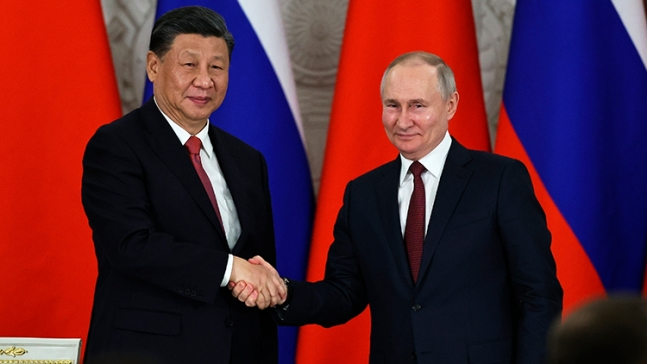
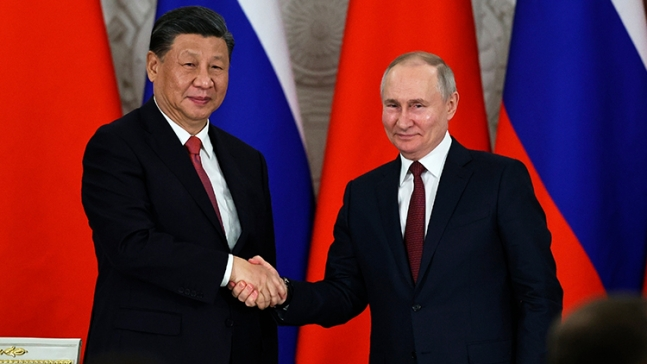
Chinese President Xi Jinping (left) and Russian President Putin / AP=Yonhap News
Meanwhile, President Putin likely sees the United States as the only country capable of obstructing his vision for a resurgent Russia. Given Russia's limited economic power, collaboration with China—an economic powerhouse engaged in strategic rivalry with the U.S.—is essential for Russia.
The official statement from China’s Ministry of Foreign Affairs about the summit highlighted these perspectives. Both Xi Jinping and Vladimir Putin repeatedly emphasized their "comprehensive strategic partnership of coordination." Putin stated that "the development of Rusia-China relations is conducive to international strategic stability" and noted that "Russia is ready to continue to expand bilateral cooperration with China keep close communication and coordination within the frameworks of the United Nations, BRICS and the Shanghai Cooperation Organization and work for more just and equitable international order". Xi Jinping also commented that the enhancde comprehensive strageic coordination between China and Russia "made positive contributions to maintaining global strategic stability and promoting greater democracy in international relations." He further emphasized the need to build "a just and equitable global governance system" through their cooperation.
These remarks from the Chinese and Russian leaders indicate that both countries are collaborating to ensure strategic stability in their relations with the United States. By advocating for “a multipolar world” and "greater democracy in international relations," they clearly oppose the U.S.-dominated international order and share a goal of establishing a "just and equitable global governance system."
Analysis of North Korea-related Content in the China-Russia Joint Statement
Building on their shared views, China and Russia released a joint statement right after the summit titled "A Joint Statement on Deepening the China-Russia Comprehensive Strategic Partnership of coordination for the New Era." This statement outlines not only how China and Russia plan to enhance cooperation in various sectors but also their intention to strengthen collaboration in the United Nations General Assembly, the United Nations Security Council, and the Shanghai Cooperation Organisation. It also details their joint stance on the Non-Proliferation Treaty (NPT) and the Biological Weapons Convention (BWC), along with their positions on issues related to the United Nations Framework Convention on Climate Change, the Convention on Biological Diversity (CBD), and marine pollution.
An interesting aspect of this statement is found in the third part, which discusses economic cooperation between China and Russia. It includes a section stating, "Both parties will engage in constructive dialogue with the Democratic People's Repubilc of Korea regarding the navigation of China vessels through the lower Tumen River to the sea." This issue is crucial for China's economic development in its northeastern region, but it has not been resolved because it requires consent from both North Korea and Russia. The inclusion of this issue in the joint statement suggests that China has raised the matter with Russia again, and Russia has agreed to discuss it with North Korea. However, if this statement was made without prior consultation with North Korea, North Korea might perceive it as pressure from China and Russia.
Another significant point concerning North Korea is found in the tenth part of the statement. Here, China and Russia oppose the hegemonic actions of the United States attempting to alter the balance of power in the region through military capability expansion and alliance consolidation in Northeast Asia. At the same time, however, they also urge North Korea and other relevant countries to resume negotiations based on the principles of mutual respect and consideration for each other's security interests. This position from China and Russia contrasts with North Korea's recent hostile policies towards South Korea.
Implications of the China-Russia Summit for North Korea Policy
Following the strengthening of military cooperation between North Korea and Russia, there have been significant concerns in South Korea about the potential for increased military ties between China, Russia, and North Korea. However, China seems to have maintained a clear boundary regarding military cooperation with either Russia or North Korea. The recent China-Russia summit included various cooperative plans in their joint statement and widespread criticism of the United States. Nevertheless, the official stance on China-Russia relations, as agreed upon by both countries, is defined by "non-alignment, non-confrontation and non-targeting of any third party."
To understand this stance, the following reasons should be considered. For China to win the strategic compettion with the United States, it must prevent Russia or North Korea from improving ties with the U.S. and turning against China. However, engaging in military cooperation or forming a military alliance with Russia—already in a hostile relationship with the U.S. due to the Ukraine war—or with North Korea, which claims a new Cold War has begun, does not benefit China. The national of three countries and the dynamics of the U.S.-China strategic competition that China, Russia, and North Korea aim to shape are quite different. This provides significant policy insights for South Korea.
Before President Vladimir Putin's visit to China, media reports predicted that he would also visit North Korea. However, after traveling to Heilongjiang Province, President Putin returned to Russia without visiting North Korea. Some interpret this decision as being influenced by China's position. Furthermore, ten days after the China-Russia summit, Chinese Premier Li Qiang attended the South Korea-China-Japan summit. Shortly after this summit, on May 27, North Korea launched a reconnaissance satellite, which some see as a sign of North Korea's dissatisfaction with China.
Following the South Korea-China-Japan-summit, a "2+2 Ministerial Dialogue" focused on diplomacy and security between South Korea and China will be held in June. If the North Korean issue can be discussed at this meeting, it could serve as an important starting point for restoring mutual trust between South Korea and China.