

Why North Korean Residents are Reluctant to Live
in Pyongyang's High-Rise New Town
North Korea has been constructing a 'New Town' in Pyongyang, each with 10,000 homes annually for five years. However, the term 'high-rise,' previously emphasized by state media, has disappeared. Instead, the term 'building density' has emerged, indicating a change in Pyongyang's new town construction methods.
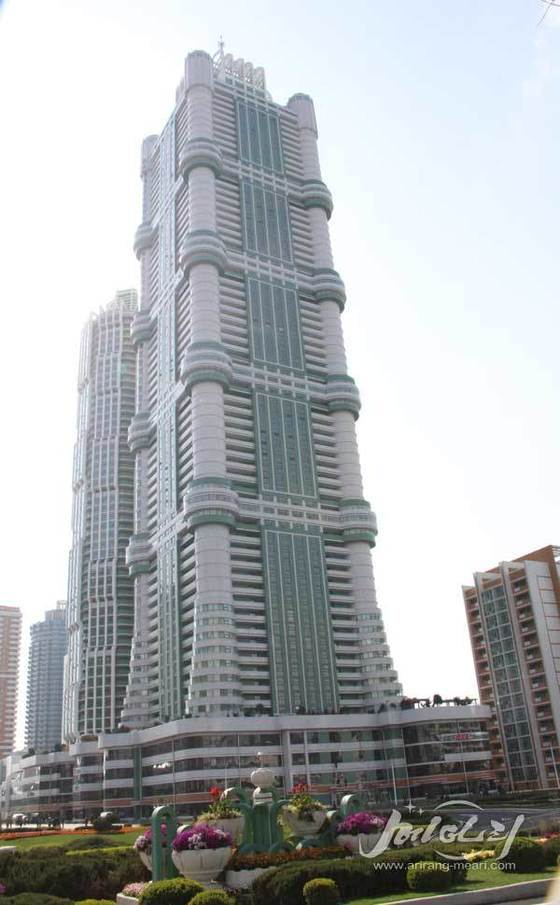
The 70-floor apartment on Ryomyong Street in Pyongyang, completed in 2017 / Meari
In 2021, during the 8th Congress of the Workers' Party of Korea, North Korea announced a five-year economic development plan to build 50,000 homes in Pyongyang by 2025, at a rate of 10,000 households per year. As a result, Songhwa Street was completed in April 2022, 'Hwasong Street' for the first-stage construction project in April 2023, and 'Rimhung Street' for the second-stage construction project in April this year.
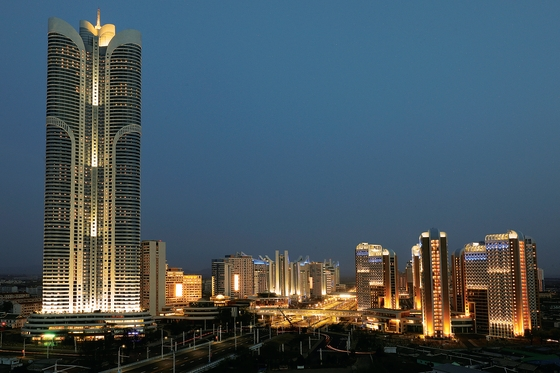
The 80-floor apartment built on Songhwa Street in Pyongyang in April 2022 / Rodong Sinmun
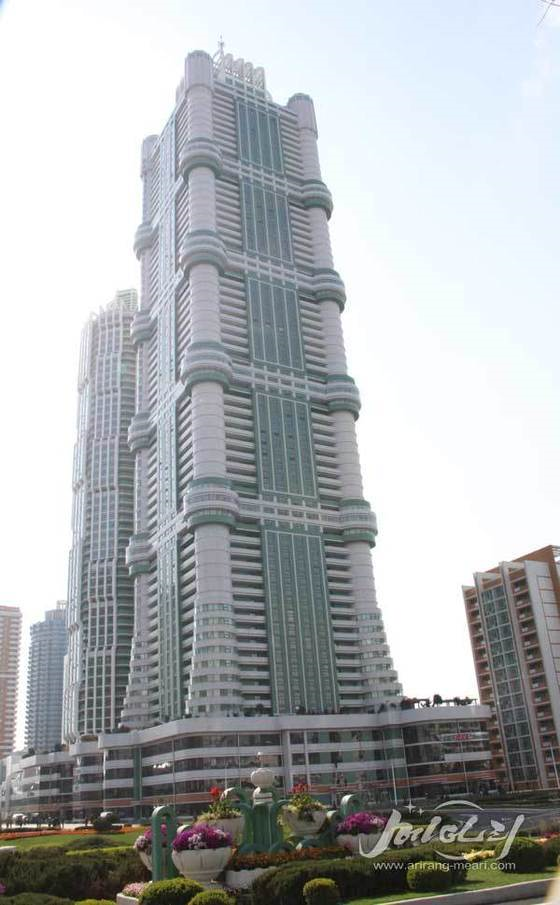
Since 2013, North Korea has built apartments for scientists and educators near major universities in Pyongyang, starting with Unha Scientists Street, followed by Wisong Scientists Residential District (2014), Mirae Scientists Street (2015), and Ryomyong Street (2017). Mirae Scientists Street features a 53-floor high-rise building, and Ryomyong Street includes a 70-floor skyscraper.
North Korean media often highlighted 'high-rises' while promoting Pyongyang's new towns. In May last year, 'DPRK Today' introduced the 53-floor apartment building on Mirae Scientists Street, the 70-floor building on Ryomyong Street, and the 80-floor building on Songhwa Street, noting the latter as "the tallest residential building in Pyongyang.“
Last year, high-rise buildings were also introduced in the first-stage construction project in the Hwasong area. In North Korea, 'high-rise' typically refers to buildings with 50 floors or more, indicating a construction method that maximizes the floor area ratio by building tall structures.
However, in the second-stage construction completed last month with 10,000 homes, the focus shifted to 'building density,' suggesting a new approach of densely packing several buildings to increase the building coverage ratio. As a result, the tallest building in the Hwasong Area's second-stage project is estimated to be under 50 floors.
Photos of the Hwasong area's second-stage project released by North Korea show that buildings are predominantly around 20 to 30 floors high.
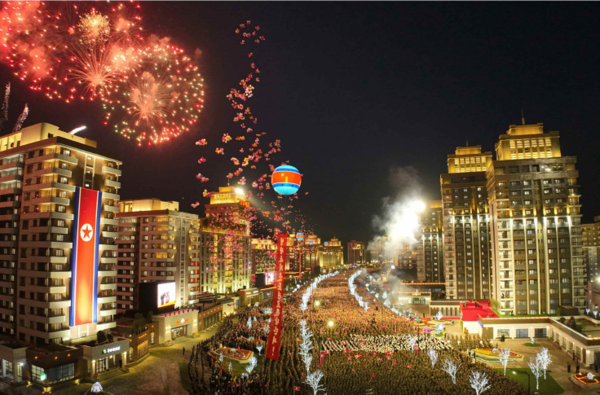
Inauguration ceremony of the New Town in Pyongyang for the Hwasong area's second-stage project, April 2024
/ Rodong Sinmun
The change in construction methods for Pyongyang's new towns may be due to the chronic electricity shortage, which makes residents avoid high-rise apartments. Lee Eun-pyeong, a North Korean defector who participated in new town construction until 2016, explained that residents are reluctant to live in high-rises because elevators only operate during commuting hours due to electricity shortages. While solar installations have somewhat resolved lighting issues, they are insufficient for operating elevators.
Additionally, during periods of high electricity demand, such as the farming season, power outages are common, often leaving elevators non-operational even during commuting hours. Water supply to high-rise buildings is also reported to be problematic. In Pyongyang, water is supplied every ten floors, but the pressure often drops after the fifth floor. Residents must carry water containers up and down stairs, and those on higher floors face such severe water shortages that even flushing toilets can be difficult.
While wealthy residents may bribe elevator operators for usage, most people must carry essentials like food, coal, gas, and oil by foot.
The rapid construction of high-rise buildings also raises safety concerns. North Korea's construction speed, such as completing an 80-story skyscraper in one year, is unimaginable in South Korea. While North Korea boasts about reducing construction time, experts point out the lack of discussion on essential infrastructure and building integrity. Instances of apartment collapses in Phyongsong in 2013 and Pyongyang in 2014, resulting in hundreds of casualties, raise concerns about the quality of construction.
It is speculated that North Korean authorities might have shifted from building high-rises to increasing building density to mitigate potential safety hazards of hastily constructed high-rise buildings, which could pose safety risks later.