

Evaluation of Chinese President Xi Jinping's Visit to France
and Its Implications for North Korea

Lee Dong-min
Professor of Political Science and International Relations at Dankook University
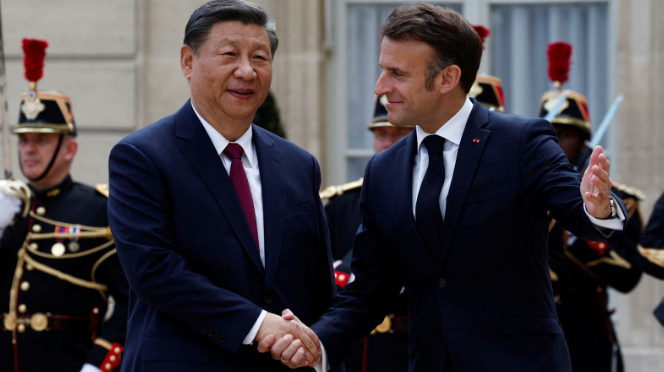
Chinese President Xi Jinping began his European tour on May 7, visiting France first, followed by Hungary and Serbia. During his meeting with French President Emmanuel Macron, Xi stated that this visit would spread "stability and positive energy in a turbulent world" through deeper cooperation between France and China. Xi emphasized his aim to build new relations with France, strengthen cooperation with other European countries, and strive for world peace and stability. Notably, amid the ongoing intense conflict between Russia and Ukraine, China expressed its intention to engage in strategic communication with France, and France responded by emphasizing the importance of this dialogue.
The implications of President Xi Jinping's visit to Europe should be examined from two perspectives. First, how will this tour, seen as a strategic readjustment of China's policy towards Europe, affect China-Europe relations, including China-France relations? Second, what are the implications of Xi's foreign activities for the Korean Peninsula, including North Korea? The first perspective involves extrapolating the macro-level international political implications, while the second assesses the impact on East Asia, particularly North Korea. This article will evaluate Xi's visit to France, highlighting China's policy towards Europe and inferring the implications for the Korean Peninsula, especially North Korea.
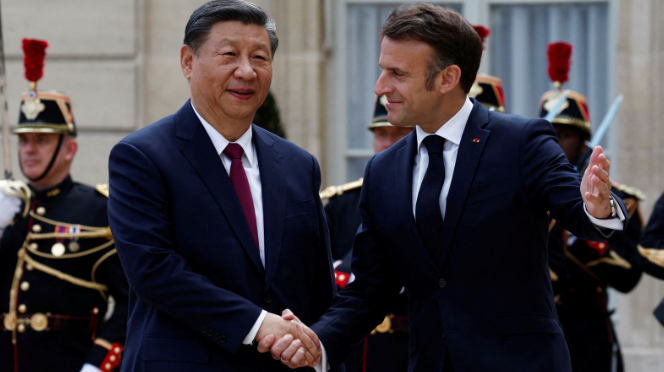
Mr Macron hosted the president at the Elysee Palace on Monday morning. Pic: Reuters
Review of China's Potential Policy Readjustment Towards Europe
Amid the intensifying strategic competition between the U.S. and China, China seems to be seeking to complete its Belt and Road Initiative (BRI) trade route by strengthening cooperation with France, a major European power. From China’s perspective, this effort reflects the tangible results of its long-pursued Go West policy and its intention to expand economic activities into Europe beyond its Eurasian integration with Russia. This strategy aims to disperse Western efforts to contain China. Particularly with restricted cooperation with the U.S. in high-tech fields under the Trump administration, China is looking for new opportunities through partnerships with technological powerhouses like France and Germany. Backed by substantial financial support from the Chinese government, Chinese companies are actively acquiring advanced technology firms in Europe to sustain their economic growth momentum through technological exchanges.
This strategic approach by China aligns with France's interests. It bolsters France’s efforts to secure strategic autonomy, a priority since the mid-1990s, and reinforces the trend of maximizing European-centered autonomy, especially after the Russia-Ukraine war. Additionally, by solidifying economic cooperation with China, France can maximize its economic benefits. France is one of the top recipients of Chinese Foreign Direct Investment (FDI) in Europe, following the UK, Germany, and Italy. French investments in China are also steadily increasing, and China is expected to continue efforts to secure stable export markets for its companies and farmers in France.
France's call for greater strategic autonomy in Europe reflects the understanding that European interests may differ from those of the United States, requiring a flexible approach. However, this does not mean increasing economic dependence on China. Instead, France aims to reduce reliance on overseas supply chains by enhancing its competitiveness through technological innovation, thereby expanding its strategic space internationally. In other words, Europe's foreign policy, including France's, should be seen as pragmatic and focused on national interests rather than pro-China.
The recent actions of French leaders reflect the current situation in Europe. On April 25, President Emmanuel Macron, in a speech at Sorbonne University, warned that "the death of Europe" could become a reality due to the rapidly changing international order. He emphasized the urgency of addressing Europe's worsening poverty and strengthening industrial capabilities through investment in technological innovation and the discovery of new growth drivers based on technological independence.
This suggests that France aims to enhance its internal capabilities and maximize national interests through economic cooperation, regardless of whether the partners are democratic or authoritarian states. Should the Russia-Ukraine war end early, Europe might restore cooperation with Russia. Countries like France and Germany, experiencing war fatigue, may find it hard to ignore the pro-Russia factions within their nations advocating for cooperation with Russia to secure cheap energy supplies essential for European economic growth.
Interestingly, Xi Jinping's subsequent visits to Hungary and Serbia, both pro-Russia countries that maintain economic cooperation with Russia despite the war, raise concerns that strengthened cooperation between these countries and China could further consolidate China-Russia ties in Eastern Europe.
These strategic positions of Europe are also linked to the potential readjustment of U.S. foreign policy. Europe’s actions may reflect considerations of a possible weakening of U.S. security commitments to Europe if domestic political instability in the U.S. increases. Albridge Colby, who oversaw the 2017 National Security Strategy (NSS) under the Trump administration, argued that the U.S. should shift its focus from actively ensuring European security to managing China's strategic rise, preventing changes in the status quo in the Taiwan Strait, and promoting an "Anti-Hegemonic Coalition" to strengthen cooperation with democratic states in East Asia.
From this perspective, France’s pursuit of strategic autonomy should be seen not as a pro-China move, but as an effort to explore new foreign policy initiatives based on a solid European identity during times of international upheaval. President Emmanuel Macron maintains that protecting democratic systems is essential and expresses concerns about authoritarian regimes. However, he also acknowledges the practicality of strengthening economic cooperation with authoritarian states like China.
Evaluation of Trends in Strengthening China-Europe Cooperation and Implications for North Korea
The trend of strengthening China-Europe cooperation and expanding Europe's strategic autonomy is likely to solidify the China-Russia alliance, which is expected to have significant indirect impacts on the Korean Peninsula, particularly North Korea.
Firstly, as Europe's strategic autonomy grows, the China-Russia alliance is expected to gain more momentum. The recent meeting between the leaders of China and France, shortly after German Chancellor Olaf Scholz's visit to China in April, reflects how Europe’s two key powers are competitively strengthening their relationships with China. In the future, countries like Hungary and Serbia are also expected to secure Chinese FDI, thereby increasing economic exchanges with China. The problem is that as cooperation between China and Russia in the economic, military, and energy sectors deepens, Europe’s closer ties with China will legitimize the China-Russia alliance. This could further tighten the relationship between the two countries, potentially weakening the effectiveness of the current international sanctions against Russia.
Secondly, if China and Russia expand their cooperation to include European countries, North Korea might try to join this new economic bloc, similar to its ties with Eastern Bloc socialist countries centered around the Soviet Union during the Cold War. If major European countries like France and Germany shift from the value-based diplomacy promoted by the Biden administration, which advocated for a united front of democracies against authoritarian states, to a more pragmatic diplomacy focused on Europe’s economic growth, this could loosen the “democracy vs. authoritarianism” confrontation. This shift might weaken the democratic alliance, potentially leading to a relaxation of sanctions against North Korea, which would benefit Pyongyang. Consequently, North Korea might prioritize cooperation with China and Russia over improving relations with South Korea, Japan, or the United States.
Thirdly, if China strengthens its ties with Europe and further solidifies its relationship with Russia, North Korea would welcome the reinforcement of the North Korea-China-Russia triangular alliance, helping it overcome international isolation. This situation could lead to North Korea becoming more dependent on China, thereby strengthening China’s strategic position. Conversely, the strengthened China-Russia alliance would provide North Korea with more strategic maneuvering space. The previously strained North Korea-China relationship, due to close North Korea-Russia ties, might stabilize.
① Economic: The deepening China-Russia relationship could help stabilize North Korea's economy.
② Diplomatic: Improvement in North Korea’s relations with South Korea, Japan, and the U.S. might become a lower priority.
③ Security: The visible North Korea-China-Russia triangular alliance could increase security instability in Northeast Asia.
On May 16, Vladimir Putin's visit to China is likely to further elevate bilateral relations. North Korea is expected to actively seek to enhance its military and security capabilities, leveraging these changes in the external environment. If permanent members of the UNSC, such as China and Russia, fail to enforce economic sanctions imposed on North Korea for its development of Weapons of Mass Destruction (WMD) like nuclear and missile capabilities, North Korea will likely exploit this strategic breakthrough. The creation of economic revitalization opportunities and a favorable international environment will bolster the Kim Jong-un regime's confidence, potentially leading to a more aggressive stance towards South Korea and raising military tensions on the Korean Peninsula.
As discussed, the growing cooperation between key European powers like France and Germany with China has significant implications. North Korea is likely to seize this opportunity to enhance its economic, diplomatic, and security position. Therefore, we must closely monitor changes in the security environment around us.
-
PREV [Political Terminology]
-
NEXT [NK Focus]