


North Korea's ICBM Launch 23 Days Post Satellite: Prelude to 7th Nuclear Test?
On the morning of the 18th, North Korea executed an Intercontinental Ballistic Missile (ICBM) launch, merely 10 hours after launching a Short-Range Ballistic Missile (SRBM) the previous night. This back-to-back missile activity by North Korea seems aimed at the forthcoming South Korea-U.S. Nuclear Consultative Group (NCG) meeting, designed to tackle the nuclear and missile threats from the North. Additionally, given North Korea's pattern of conducting nuclear tests after ICBM launches, this recent ICBM launch could signal an impending 7th nuclear test.
The Republic of Korea Joint Chiefs of Staff reported that at around 8:24 AM, the South Korean military detected North Korea's launch of a suspected long-range ballistic missile into the East Sea from near Pyongyang City. This ICBM launch, North Korea's first in over five months since July 12th, comes just 23 days after launching a long-range rocket with a reconnaissance satellite.
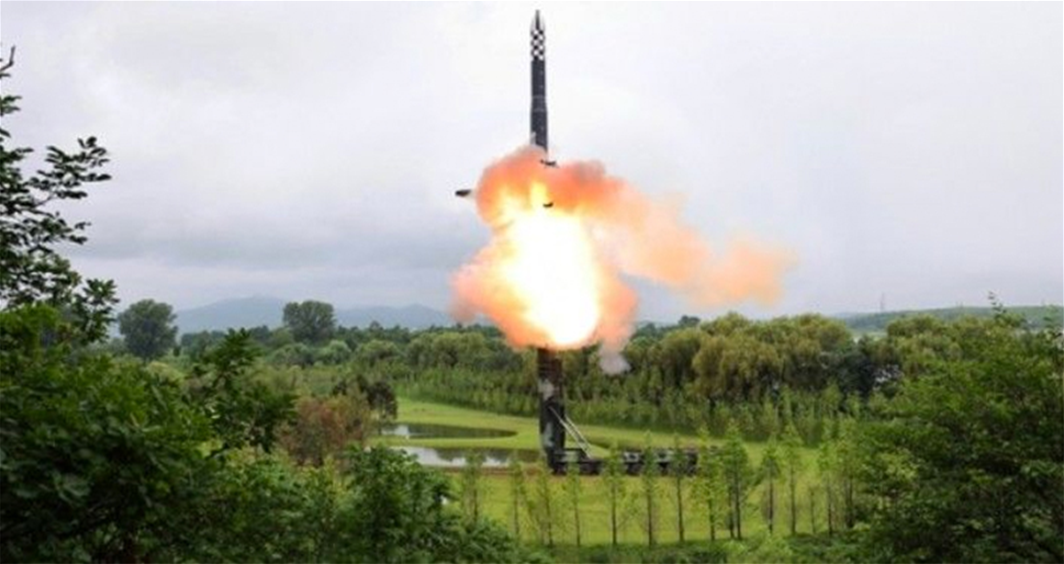
North Korea announced the long-range ballistic missile launched on July 12th as ICBM ‘Hwasong-18’/ RodongSinmun
Following North Korea's launch of a suspected ICBM into the East Sea, the South Korean Presidential Office convened a National Security Council (NSC) meeting on the 18th to deliberate on responses. The South Korean military firmly condemned the launch as a blatant violation of United Nations Security Council resolutions, linking it to North Korea's unlawful nuclear development. To date, North Korea has conducted 18 ballistic missile launches this year.
South Korean and U.S. authorities anticipated that North Korea might launch an ICBM or a new type of solid-fuel-based intermediate-range ballistic missile (IRBM) as early as this month and had heightened their readiness. Amidst this, North Korea fired an SRBM on the 17th, followed by a suspected long-range ballistic missile, likely an ICBM, the next day.
North Korea's SRBM launch was analyzed as targeting the USS Missouri, a U.S. nuclear-powered submarine that had docked at the Busan Naval Base. The Joint Chiefs of Staff reported on the day, “At around 10:38 PM today, our military detected a missile, presumed to be a short-range ballistic missile, launched from the vicinity of Pyongyang City into the East Sea, which flew approximately 570km before landing in the East Sea.” The launch direction of North Korea's short-range missile could reach the Busan base if aimed that way, given the approximate 550km distance from Pyongyang City to the base.
The South Korean government hinted at a response at the NCG level regarding North Korea's ICBM test launch. Kim Tae-hyo, Deputy Director of the National Security Office, mentioned to reporters upon arrival at Incheon International Airport on the 17th afternoon, “Since the ballistic missile has the potential to be nuclear-capable, it is certainly a matter of concern for the NCG.”
North Korea's ballistic missile launch is seen as a reaction to the agreement made during the second South Korea-U.S. NCG meeting to conduct nuclear operational exercises during the 'Ulchi Freedom Shield (UFS)' joint military exercise next August.
Indeed, shortly after the SRBM provocation on the 17th, at around 11:08 PM, the North Korean Ministry of Defense issued a spokesperson's statement through the Korean Central News Agency, sharply criticizing the results of the NCG meeting as an "overt declaration of nuclear confrontation."
The consecutive SRBM and ICBM launches by North Korea are seen as related to its reconnaissance satellite launch 23 days earlier. This satellite, aimed at enhancing surveillance against South Korea-U.S. allied forces, also serves as the 'eye' for nuclear attacks, improving North Korea's ability to target crucial military sites in South Korea, the U.S., and Japan.
In the 7th Congress of the WPK in 2021, Kim Jong-un proposed improving the accuracy of a 15,000 km ICBM as a key task of the 'Five-Year Plan for the Development of National Defense Science and Weapons System.' This suggests a need to demonstrate and enhance the precise strike capability of the ICBM, considering doubts over its Circular Error Probability (CEP) and actual capability to reach the U.S. mainland.
There's also speculation that North Korea set the targets for the SRBM and ICBM based on military intelligence gathered through its own reconnaissance satellite.
Amidst this, North Korea's launch of an ICBM following the reconnaissance satellite raises the possibility of proceeding with a 7th nuclear test. Historically, North Korea has followed a pattern of conducting nuclear tests after long-range rocket and satellite launches. This recent ICBM launch could be seen as a preparatory stage for a nuclear test.
In August 1997, North Korea launched the Taepodong-1 missile carrying the ‘Kwangmyongsong-1’ satellite. This was followed by a test launch of Taepodong-2 in July 2006 and then the first nuclear test in October 2006. Furthermore, after launching the Unha-2 long-range missile carrying the ‘Kwangmyongsong-2’ on in April 2009, North Korea conducted its second nuclear test a month later.
In December 2012, after launching the ‘Unha-3’ with ‘Kwangmyongsong-3 Unit2’,they conducted its third nuclear test in February 2013.
The order changed for the fourth nuclear test. In January 2016, North Korea tested a hydrogen bomb for the fourth experiment, followed by a test of a long-range missile carrying ‘Kwangmyongsong-4’ in February. Before the fifth nuclear test in September 2016, North Korea tested the submarine-launched ballistic missile (SLBM) ‘Pukguksong-1 (KN-11)’. In July 2017, North Korea first launched the ICBM ‘Hwasong-14’ and then conducted its sixth nuclear test in September. This indicates a close link between North Korea's ballistic missile program and nuclear tests.
Therefore, if North Korea conducts a nuclear test following this ICBM launch, it is likely to test the tactical nuclear weapon ‘Hwasan-31’ that it has already unveiled. North Korea is expected to demonstrate that the ‘Hwasan-31’ tactical nuclear weapon, based on the KN-23 series of tactical guided missiles, super-large multiple launch rockets, short-range missiles, SRBMs, and nuclear torpedoes, can also be mounted on ICBMs.
North Korea is expected to conduct its 7th nuclear test following the ICBM launch, anticipating China and Russia's veto of UN Security Council resolutions on sanctions amidst the New Cold War. In light of these provocations, the military readiness of South Korea and the collaborative efforts among South Korea, the U.S., and Japan are more crucial than ever.