

By Sarah Han
Guest Research Fellow at the Sand Institute
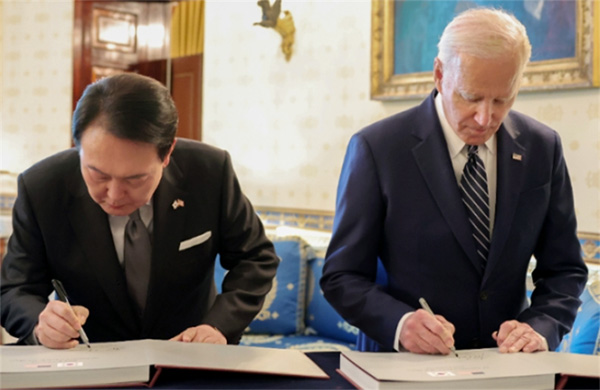
South Korea and the United States announced the first-ever joint statement on expanded deterrence, called the "Washington Declaration." on April 26, 2023. The main focus is on creating more practical and effective measures for "Korean-style deterrence" in response to the heightened North Korean nuclear threat. The statement aims to solidify and institutionalize the US commitment to deterrence while also increasing South Korea's involvement in the process.
This joint statement is the result of over a year of discussions between South Korea and the United States, particularly since the start of the Yoon Seok-youl administration. It is also significant in that it highlights the unwavering cooperation between the two countries in responding to the North Korean threat, coinciding with the 70th anniversary of the South Korea-US alliance.
The joint statement includes the establishment of a Nuclear Consultative Group (NCG) and the regular deployment of US strategic assets such as Strategic Submarine Ballistic Missile (SSBN) on the Korean Peninsula. It also includes simulations to prepare for nuclear crises and other specific operational details of expanded deterrence.
This is interpreted as a way to increase South Korea's involvement in the US decision-making process regarding nuclear responses on the Korean Peninsula and establish a channel of continuous communication between the two countries. The NCG will hold four regular meetings per year and report the results to the presidents of both countries.
After the summit, President Yoon stated at a joint press conference that "the strengthened deterrence and its operational methods are different from the past, and I expect that many concerns about the North Korean nuclear threat will be eased." He emphasized that "the US has never shared information or planning on nuclear assets with any individual country except NATO (North Atlantic Treaty Organization). Therefore, the new expanded deterrence measures are stronger."
Kim Hyun-wook, a professor at the National Diplomatic Academy, evaluated that "the actual core of the NCG is sharing of US nuclear operation and decision-making." As President Yoon stated, the US does not share any nuclear operation matters with any individual country other than NATO.
Kim Hyung-seok, a former vice-minister of Unification, also commented that "South Korea and the United States have found the maximum common ground they can reach," and that "having South Korea possess its own nuclear weapons would be the best option, as it would allow South Korea to use them at will. However, the decision was made based on a realistic assessment of what can be done."
The US is currently operating NATO and the Nuclear Planning Group (NPG), and the NCG appears to have been established based on these models.
Former Vice Minister Kim also evaluated that the summit had found "the maximum common ground that the US and South Korea could achieve." While the US did not allow South Korea to possess its own nuclear weapons, it was significant that the US and South Korean leaders made it clear that a reckless nuclear attack by North Korea was not possible. Kim emphasized that the regular deployment of US strategic assets on the Korean Peninsula would send a big message to North Korea, which would receive it sensitively.
Some evaluations suggest that the summit was more of a political symbol commemorating the 70th anniversary of the US-South Korea alliance than a meeting to address major issues between the two countries.
Professor Park Won-gon of Ewha Womans University's Department of North Korean Studies stated, "It was the best outcome given the given circumstances." He analyzed that the agenda was limited and that the establishment of the NCG was a good start. Furthermore, he explained that "it is enough to find meaning in the fact that President Biden expressed his intention to suppress the expansion of Japan and that it has been formalized and a consultative body has been established. The more important question is how it will be operated in the future."
Meanwhile, Japanese Prime Minister Yoshihide Suga will visit South Korea from May 7-8. It has been more than two months since the Tokyo Summit between Japan and South Korea in March. The Japanese Prime Minister's visit to South Korea is the first in 12 years, and he is reportedly scheduled to visit the National Cemetery as his first itinerary.
Japanese media reported unanimously on April 30th that "Kishida's early visit to Korea, without much time passing since President Moon's visit to Japan in March, is in response to President Moon's proactive stance towards improving Japan-Korea relations to accelerate the improvement of the relationship." They also diagnosed that "the background of the early visit is to showcase the importance of the Japan-Korea bond that the US values and that the US's intention is also a major factor in the visit."
U.S. President Joe Biden emphasized US-South Korea-Japan cooperation during the US-South Korea summit with President Moon on April 26 in Washington, D.C.
President Yoon said that the recent visit of Japanese Prime Minister Kishida marked the beginning of breaking the ice in shuttle diplomacy and expressed his hopes for positive results from the upcoming South Korea-Japan summit. He emphasized the need to continue to lead the South Korea-Japan relationship in a constructive direction. President Yoon also stated that the South Korea-Japan relationship has begun to improve and the South Korea-U.S.-Japan relationship is in a virtuous cycle, stressing the importance of building stronger trilateral ties.
Experts predict that North Korea's reaction to the strengthening of ties between the U.S., South Korea, and Japan will be complex and uncomfortable. Choi Kyung-hui, representative of the Sand Institute, said that North Korea has always been uncomfortable with the combination and strengthening of the alliance between South Korea, the U.S., and Japan. She added that from North Korea's perspective, it is uneasy to see South Korea's economy rapidly developing and forming a stronger bond with the reliable allies of the U.S. and Japan.
Unlike the Cold War era, where South Korea's status was lower, the country now has a higher standing, and its relationship with Japan is being built in a cooperative rather than a confrontational manner. As North Korea has been pursuing the maximization of its nuclear value, experts suggest that North Korea's perspective on the situation will be uncomfortable.
In fact, North Korea has been expressing animosity towards South Korea since the South Korea-U.S. summit, even conducting a scarecrow-style demonstration targeting the two countries' leaders, which is an unusual move. On May 3rd, North Korea's state-run Korean Central News Agency reported on a student rally criticizing the Washington Declaration, saying, "Those who enjoy fire have nowhere to go but in the fire I lit."
North Korea has previously expressed hostility towards South Korea and the U.S. through events such as joint military exercises, but this time, they have directed their criticism at the South Korea-U.S. and South Korea-Japan summits.
It seems to express extreme dissatisfaction with the 'Washington Declaration' of the South Korean and U.S. leaders, which contains measures to strengthen the suppression of expansion.
On the 29th of last month, Kim Yo-jong, deputy director of the North Korean Labor Party, strongly criticized President Biden as "an old man with no future" and President Yoon as "a wretched human being" in response to the adoption of the 'Washington Declaration'.
In response, the South Korean government countered the claim as "forced." The Ministry of Unification issued a statement on the same day regarding Kim Yo-jong's announcement, stating that it "condemns the groundless claim made in a hostile manner against the South Korea-U.S. summit."
In particular, the ministry said, "It seems that North Korea's anxiety and frustration about the drastic enhancement of the nuclear deterrence of the South Korea-US alliance was reflected in its hasty and groundless claims as soon as the Washington Declaration was announced," and warned that "If North Korea continues to take the wrong path, it will face even stronger and overwhelming responses, and the lives of North Korean residents will be even more devastated."
And "We should recognize that Kim Yo-jong's disrespectful language to insult the national leaders of South Korea and the US with rude language only shows North Korea's inferior level, and it will be a laughing stock in the international community." the ministry added.
Amid the strengthening of the Korea-U.S. alliance, President Yoon and Japanese Prime Minister Kishida Fumio held a summit in Seoul on May 7, to discuss bilateral relations and cooperation in various fields.
Following the summit, President Yoon expressed his belief at a press conference that the shuttle diplomacy between the leaders of the two countries and normalization of bilateral relations were on track with Prime Minister Kishida's visit. In response, Kishida stated that the shuttle diplomacy between South Korea and Japan will continue and that they will meet frequently, including in Hiroshima and at international conferences, to enhance Japan-Korea relations through building trust.
Regarding the Fukushima site inspection, Kishida assured that they are aware of concerns from within South Korea and will not accept any form of discharge that could negatively impact the health of Japanese and South Korean citizens and the marine environment.
Kishida also expressed his appreciation for the South Korean government's efforts in dealing with measures related to the forced labor compensation law announced on March 6, thanks to President Yoon's decision.
Professor Park Won-gon suggests that the improvement of South Korea-Japan relations and the strengthening of cooperation among South Korea, Japan, and the United States is largely motivated by the North Korean threat. He argues that without the nuclear and missile tests conducted by North Korea, achieving this level of cooperation would have been difficult.
In addition, Park emphasizes that the alignment of understanding among South Korea, the United States, and Japan and the restoration of South Korea-Japan relations, which were previously considered difficult to achieve, have become possible due to North Korea's actions.