


Kim Myongsung’s Inside North Korea
· Pyongyang's Donju Collapse and Market Decline: Ethnic Chinese Residents Report
· Emergence of Kim Ju-ae and Strategic Value Changes in the WPK
· Kim Jong-un’s Repeated Visits to Flood-Affected Areas: Shifting Blame to Natural Disasters and Avoiding Government Responsibility

Kim Myong-sung
As North Korea intensifies its anti-market policies, reports suggest that Pyongyang's Donju (wealthy patrons) class is collapsing, and individual businesses are failing. The SAND Institute's English newsletter team interviewed two ethnic Chinese residents of Pyongyang who recently obtained visas to travel to Dandong, China. For safety, they requested anonymity. They revealed that anti-socialist policies and trade company restructuring have led to the downfall of the once-prosperous Donju, causing most small business owners of restaurants and shops to go bankrupt.
One resident, referred to as A, mentioned that since last year, North Korea has moved most trade companies from the party, government, and military to the cabinet. These Donju, executives at foreign currency-earning companies, had amassed considerable wealth through legal and illegal trade, living lavishly in Pyongyang. A explained, "Except for companies tied to major power agencies like the Ministry of State Security, most have been transferred to the cabinet, reducing the Donju from managers to ordinary workers overnight.“
Another resident, B, reported that crackdowns on individual commercial activities in Pyongyang have intensified. "Enforcement on high-end restaurants, bars, and market stalls is so strict that many merchants have given up," B said. An acquaintance running a bar in Pothonggang District had to close due to frequent inspections. Various agencies, including the Workers' Party of Korea, Ministry of State Security, Ministry of Social Security, and anti-socialist task forces (TF), visit shops daily to extort bribes. After paying these bribes, merchants incur losses, forcing them to shut down.
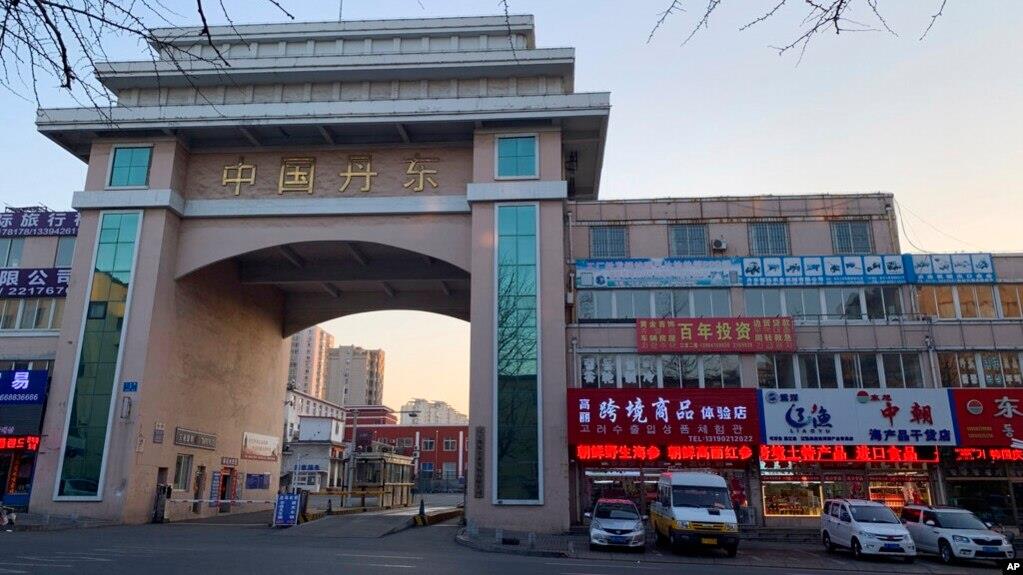
Customs Scene at Dandong, China, Before the COVID-19 Pandemic in 2019 / VOA
A reported that enforcing the Reactionary Ideology and Culture Rejection Law and anti-socialist crackdowns has worsened living conditions in Pyongyang. However, ethnic Chinese residents found some relief as travel to China resumed after COVID-19 lockdowns.
A mentioned that 43 ethnic Chinese residents of Pyongyang were selected after fierce competition to board a bus to China in early July. A stated that they had to bribe officials with 5,000 yuan to obtain the visa and an additional 3,000 yuan to expedite their selection for the China-bound bus.
B noted that many Pyongyang residents, facing economic hardships, often seek to befriend or even marry ethnic Chinese involved in trade with China. "In the past, Pyongyang residents were wary of ethnic Chinese due to their background, but now they approach them for marriage," B said.
A stated, "In Pyongyang's markets, you can buy anything if you have money, but merchants hide good products under their stalls due to crackdowns. Ethnic Chinese can order anything, and merchants will bring out the hidden items at the agreed time.“
Meanwhile, it is reported that after North Korea proposed policies to reduce market activity and expand the state-run commercial network during the 8th Congress of the Workers' Party of Korea in 2021, it has been gradually implementing these policies along with wage increases. While the increased wages allow for the purchase of food at lower prices from state-run food stores compared to markets, the amount is insufficient for a normal lifestyle.
B, an ethnic Chinese resident in Pyongyang, said, "Many people are dissatisfied with the authorities' policy to reduce the market area, which is a capitalist element, and make all residents employees of state-owned enterprises. Ethnic Chinese who have traveled to China are trying to extend their stay and delay their return to Pyongyang as much as possible."
Emergence of Kim Ju-ae and Strategic Value Changes in the WPK
Speculation is mounting about the emergence of Kim Ju-ae, the daughter of North Korean leader Kim Jong-un, as a potential successor.
Last month, the National Intelligence Service reported to the National Intelligence Council that North Korea is hinting at Kim Ju-ae as a likely successor. She is being trained for succession while the regime carefully manages public reactions to her, adjusting propaganda levels and public exposure, and guiding her through private activities.
While future changes are possible, it seems highly likely that Kim Ju-ae is the fourth-generation heir of the Kim family at this time.
If Kim Ju-ae becomes the successor, it would mark the first female leader in North Korea, indicating a significant shift in the nature of North Korean power.
On June 12, North Korea's Workers' Party newspaper, Rodong Sinmun, highlighted Kim Jong-un's speech at the completion ceremony of the Central Cadres Training School of WPK on May 22, in an article titled "Strategic Values of WPK."
It is notable that Kim Ju-ae came into the spotlight after Kim Jong-un mentioned 'successor' during his 2022 visit to the Central Cadres Training School of WPK. Two years later, he revisited the school and made another important speech.
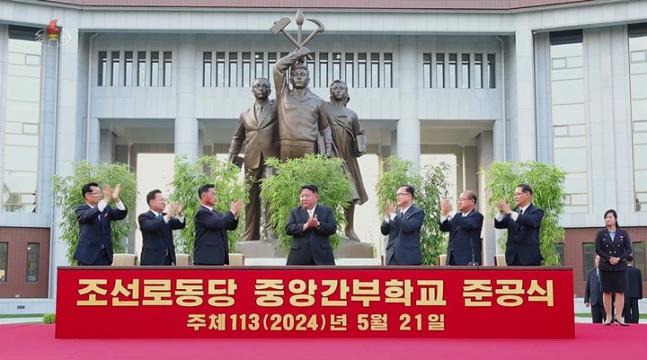
North Korean Chairman Kim Jong-un attending the completion ceremony of the Central Cadres Training School of WPK
on May 21, applauding./Korean Central Television
According to Rodong Sinmun, Kim Jong-un said in his speech at the completion ceremony of the Central Cadres Training School of WPK, "The Central Cadres Training School of WPK is emerging as a prestigious revolutionary university nurturing successors, further enhancing its reputation."
Kim Jong-un further emphasized the strategic values of WPK, stating, "The nearly 80-year history of the Central Cadres Training School of WPK begins and achieves the historical cause of succession by arming and nurturing party cadres. The most prioritized task in envisioning and designing the bright future of the party and the revolution is to excellently build the base for party cadre training." Analysts suggest that this is a call to thoroughly prepare party cadres to support the fourth-generation succession centered around Kim Ju-ae.
At 40, Kim Jong-un revived the "Oath of Loyalty" meeting on his January 8 birthday after 12 years, created a badge featuring his image, and is now believed to be preparing for the fourth-generation succession by promoting Kim Ju-ae.
If Kim Ju-ae becomes the successor, many changes will be required in the terms used to describe North Korea's supreme leader and the ruling WPK.
In North Korea, the common term for Kim Il-sung, Kim Jong-il, and Kim Jong-un is 'Father.' The term 'Father' is an honorific for 'father.' North Korea defines itself as 'one big family,' with the supreme leader, the Suryong, as the 'Father,' and the ruling WPK as the 'Mother.' This applies Confucian logic where the 'Father Leader' and the 'Mother Party' play the roles of parents in a big family.
Therefore, if the female Kim Ju-ae becomes a North Korean leader, the title 'Father' cannot be used. The titles previously given to women of the Kim family in North Korea include 'Mother of Korea' (Kang Ban-sok), 'Mother of the Revolution' (Kim Jong-suk), and 'Mother of the Military First Policy' (Ko Yong-hui).
The first female ruler in Korean history was Queen Seondeok of Silla, who ascended to the throne in 632, about 1,300 years ago.
When Jinpyeong of Silla died without a son, the Hwabaek council, the highest decision-making body of Silla, appointed Jinpyeong's daughter Seondeok as the new ruler, bestowing her with the honorific title Seongjo Hwanggo, meaning 'holy ancestor empress.‘ Recently, North Korea has been emphasizing the Baekdu bloodline, and it is likely that Kim Ju-ae will be given the title 'Noble Leader of the Baekdu Bloodline.’
If Kim Ju-ae is titled 'Mother' and the WPK is titled 'Father,' changing their roles, it would signify a fundamental shift in power, leading to significant contemplation by North Korean authorities over her title.
Kim Jong-un’s Repeated Visits to Flood-Affected Areas: Shifting Blame to Natural Disasters and Avoiding Government Responsibility
On August 8-9, Kim Jong-un visited flood-affected areas in Sinuiju and Uiju County, North Pyongan Province, following heavy rains, and announced that 15,400 vulnerable flood victims, including children, would be sent to Pyongyang for protection.
According to North Korean media such as Rodong Sinmun, Kim Jong-un visited the tents where flood victims were staying, offering comfort by holding hands and personally dressing children in department store clothes he had brought and feeding them snacks.
He also brought flood relief supplies and food on his private train and instructed party officials to distribute them directly.
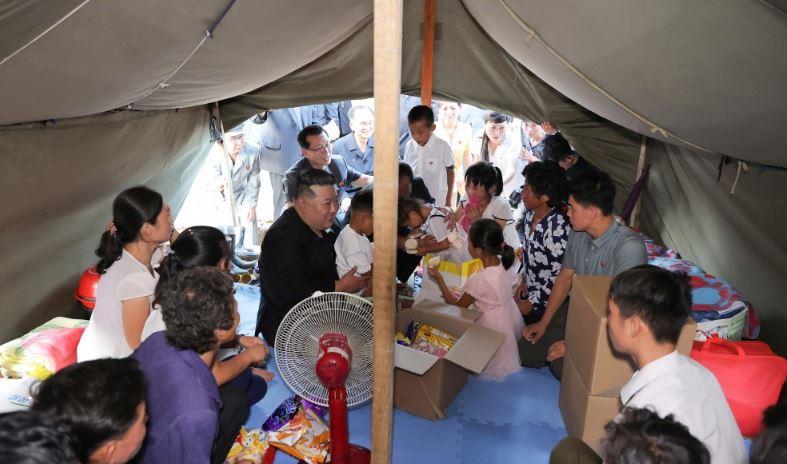
Kim Jong-un visiting the flood-affected areas of Uiju County in North Pyongan Province in May to comfort flood victims.
/Korean Central Television
North Korean media focused on close-up images of children receiving gifts and residents tearfully holding Kim Jong-un's hand.
North Korean media emphasized that the flood was an 'unavoidable natural disaster,' deflecting responsibility from the government. Kim Jong-un pointed out the 'chronic vulnerability' of Uiju County and Sinuiju areas, which turn into reservoirs during heavy rains, and instructed scientific evaluations and realistic measures to address this.
The Amnok River area, which was hit by floods, has previously suffered flood damage in 2010, 2012, and 2016. While China built barriers on the opposite side of the Amnok River to prevent damage, North Korea suffered significant losses. The government has avoided taking responsibility, blaming the floods solely on natural disasters.
Kim Jong-un also criticized South Korean media for fabricating reports on the flood damage, saying, "They are trying to deceive their people and shake world opinion with nonsense that demeans us." He emphasized, "The enemy is an unchangeable enemy," and said, "We must use this opportunity to properly understand the nature of the enemy.“
Kim Jong-un also declared that despite the severe flood damage, North Korea would not accept external aid. This is interpreted as an attempt to prevent negative internal impacts on the regime that could result from accepting external flood relief.
-
PREV [NK Focus]
-
NEXT [NK Focus]